
Kitchen walls tend to collect whatever is practical first—cabinets, shelves, rails, maybe a clock. That makes the empty sections in between surprisingly useful when you want to bring a little personality into the room.
These Kitchen Wall Decor examples go in very different directions. There are framed recipes, sculptural metal pieces, plate collections, painted or patterned walls, open shelving, woven baskets, botanical art, typography, and even a full wall of herbs. Some are mostly decorative; others make everyday kitchen storage part of the display.
Oversized Letters With Vintage Kitchen Pieces
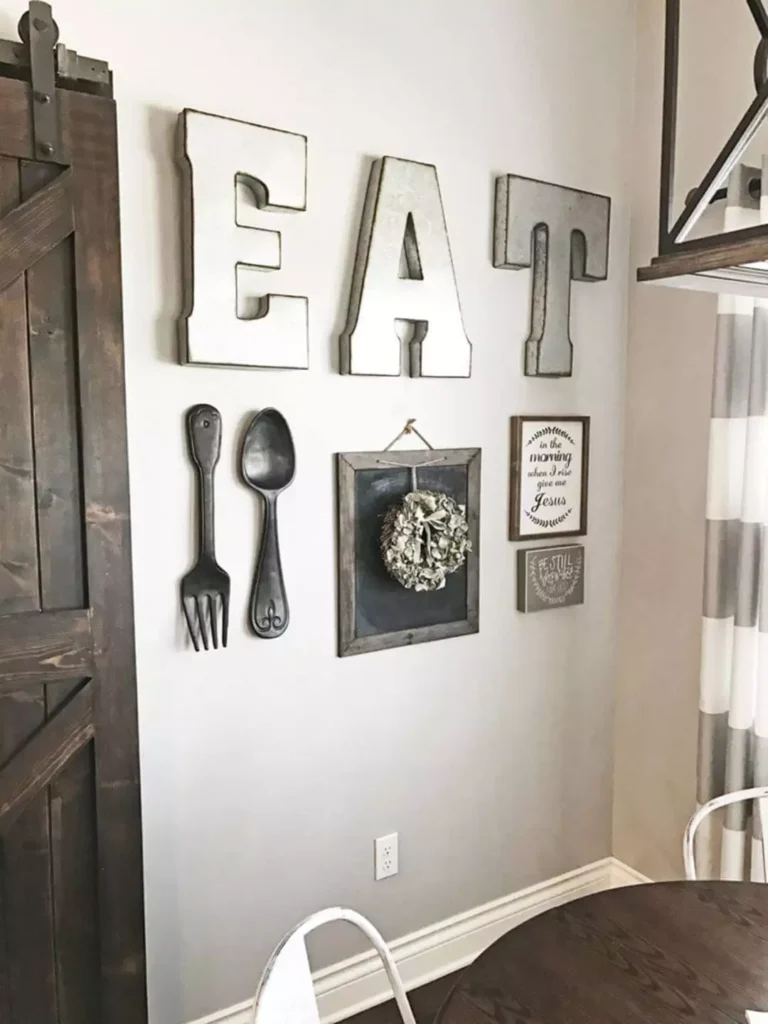
Large metal-style letters spelling out “EAT” take up most of this narrow wall, so the message reads clearly from across the room.
Oversized spoon-and-fork pieces sit underneath, with a couple of smaller framed accents nearby. The different shapes stop the arrangement from looking like one giant sign, while the neutral finishes suit the rustic furniture around it.
There is plenty happening, but everything stays within the same vintage kitchen theme.
A Sunny Gallery Wall With Food and Travel Art
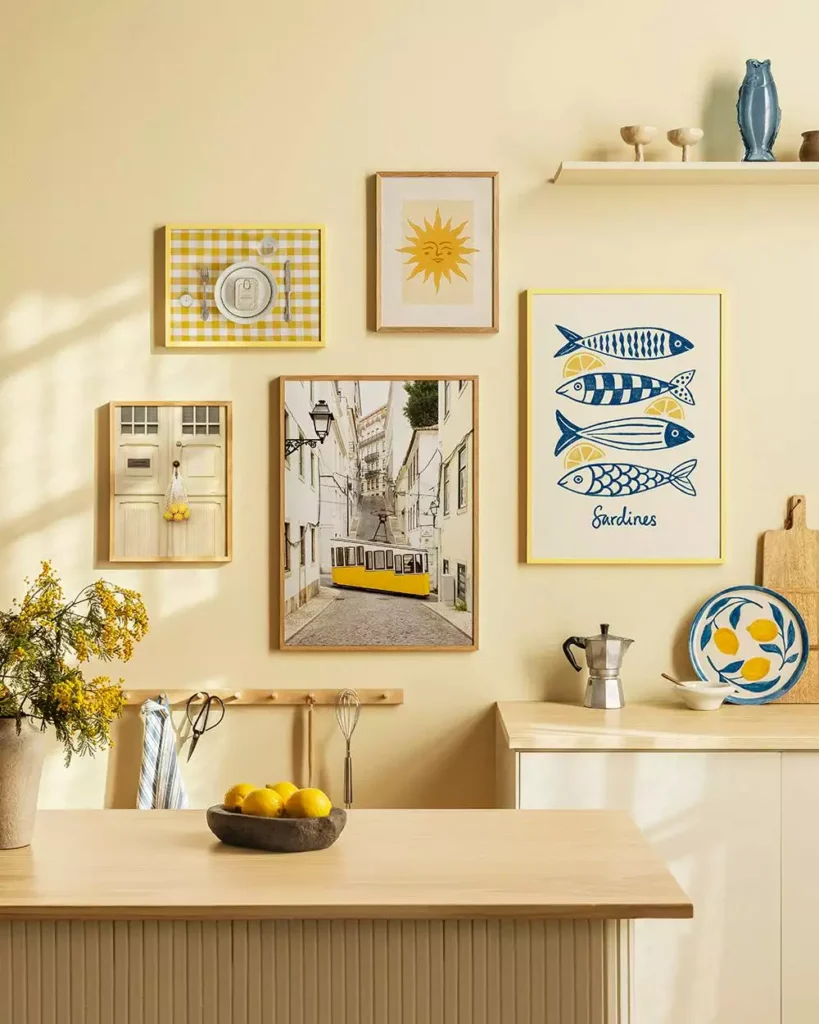
This gallery mixes several small framed pieces instead of centering everything around one large print. A fish illustration, sunny yellow artwork, a street scene, and another small graphic piece all share the wall.
The yellow tones repeat from frame to frame and connect with the bowl of lemons below. That repeated color is what holds together subjects that otherwise have very little in common.
It feels cheerful without turning the whole kitchen into a themed space.
Metal Sculpture and a Grid of Colorful Plates
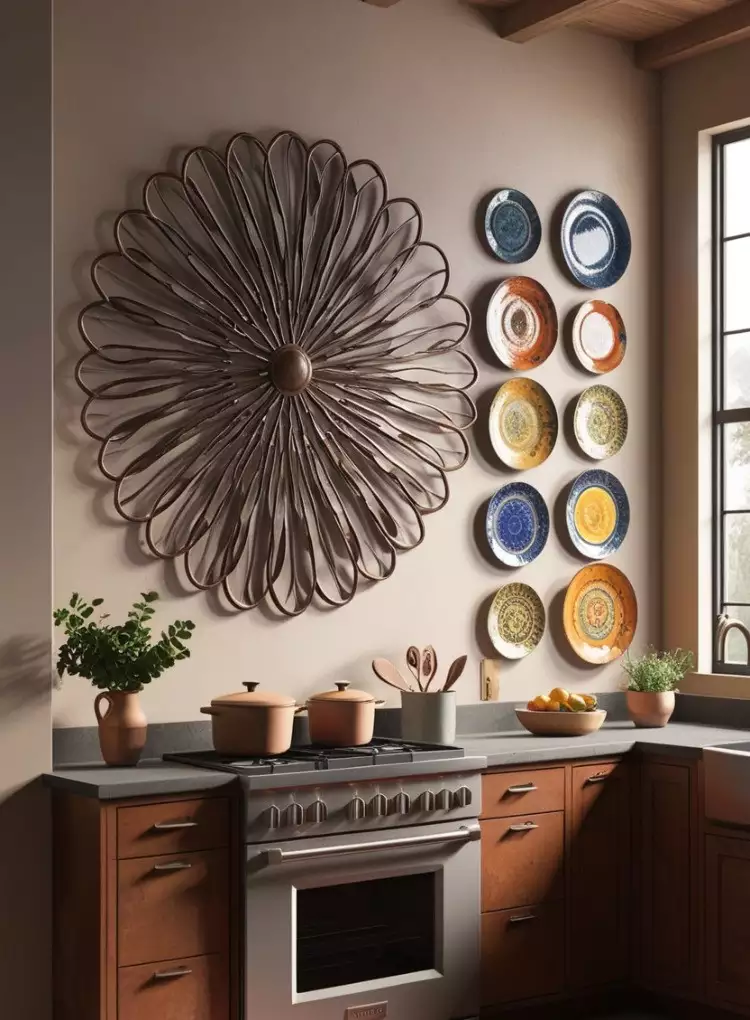
A huge flower-like metal sculpture dominates one side of the cooking wall, while a vertical grid of colorful plates fills the narrower strip beside it.
The contrast is what makes this interesting. One piece is large, dark, and sculptural; the other arrangement is made from smaller circles in blue, yellow, orange, and cream.
Because both displays have strong rounded shapes, they still make sense beside each other even though the materials are completely different.
A Kitchen Command Wall That Actually Looks Decorated
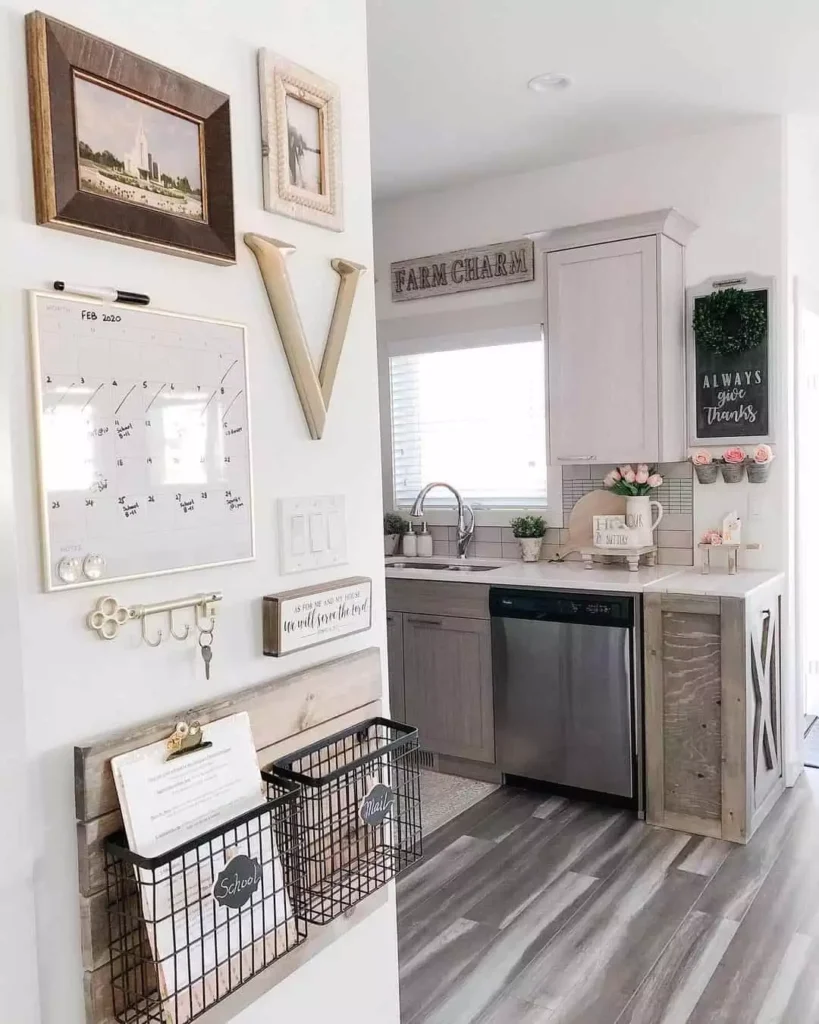
A calendar, oversized letter, framed pieces, and wire baskets turn this wall into more than decoration.
The upper half handles the visual side, while the black wire baskets lower down provide useful storage. Keeping everything within a fairly neutral farmhouse palette stops all those practical elements from looking messy.
This is one of the more functional walls in the collection, and that is really its strength.
Lemon Branches Around a Black Archway
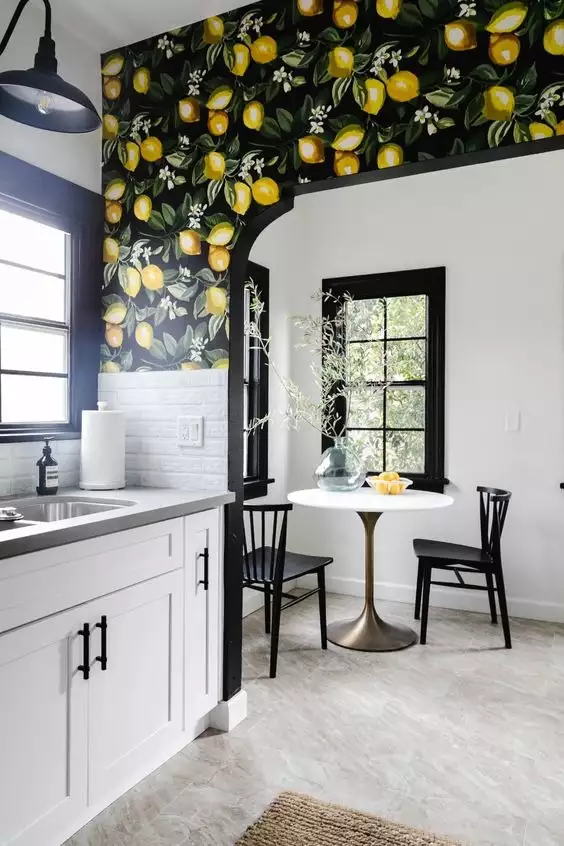
Lemon-covered branches spread around the upper wall and follow the curve of a black arched doorway.
The dark doorway gives all those yellow lemons and green leaves a strong border, while the white cabinetry below keeps the surrounding kitchen bright.
Rather than hanging something in the middle of the wall, the decoration uses the architecture that is already there. That makes the doorway itself the focal point.
Open Corner Shelves With Everyday Pieces
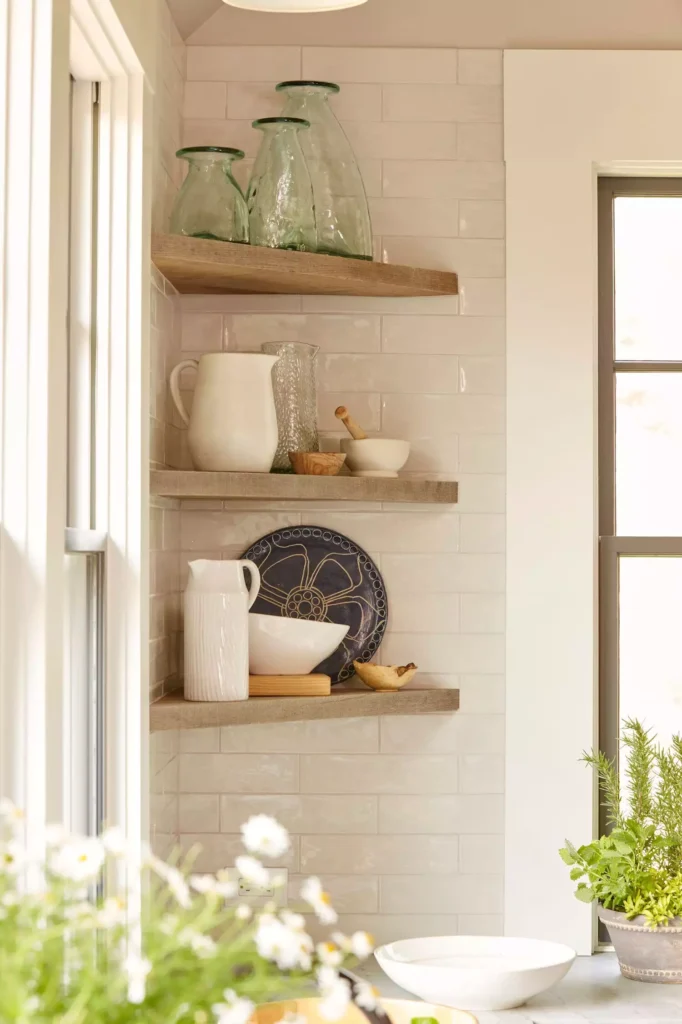
Three small wooden shelves fit neatly into this bright kitchen corner. Clear bottles, pale pitchers, bowls, and a dark blue plate give the shelves enough variation without packing them full. The simple ceramics also sit comfortably against the pale tiled wall.
It is a modest display, but the corner would feel noticeably emptier without it.
Kitchen Wall Decor on a Slim Brass Ledge
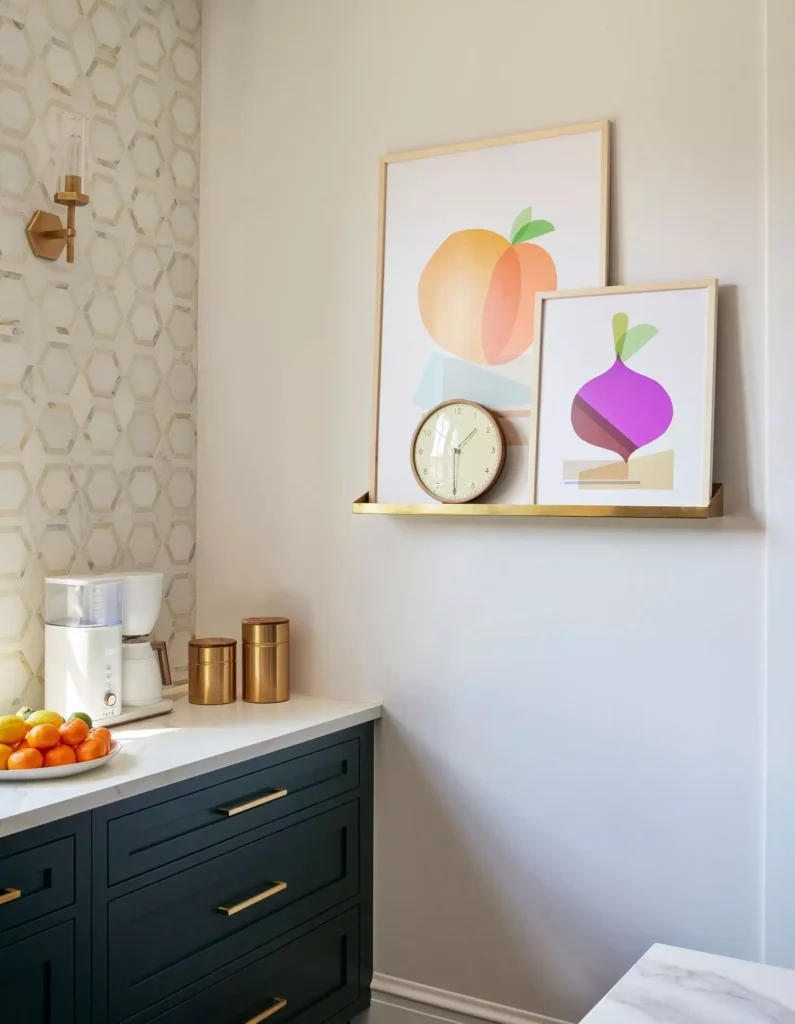
A narrow brass-toned ledge holds two colorful fruit prints and a small round clock.
The artwork leans rather than hangs, which makes the display feel more relaxed, while the warm metal strip adds a little shine against the pale wall. Dark lower cabinetry gives the small arrangement more contrast underneath.
This is Kitchen Wall Decor that does not need much depth or wall space to make a difference.
A Playful Print Above Green Cabinets
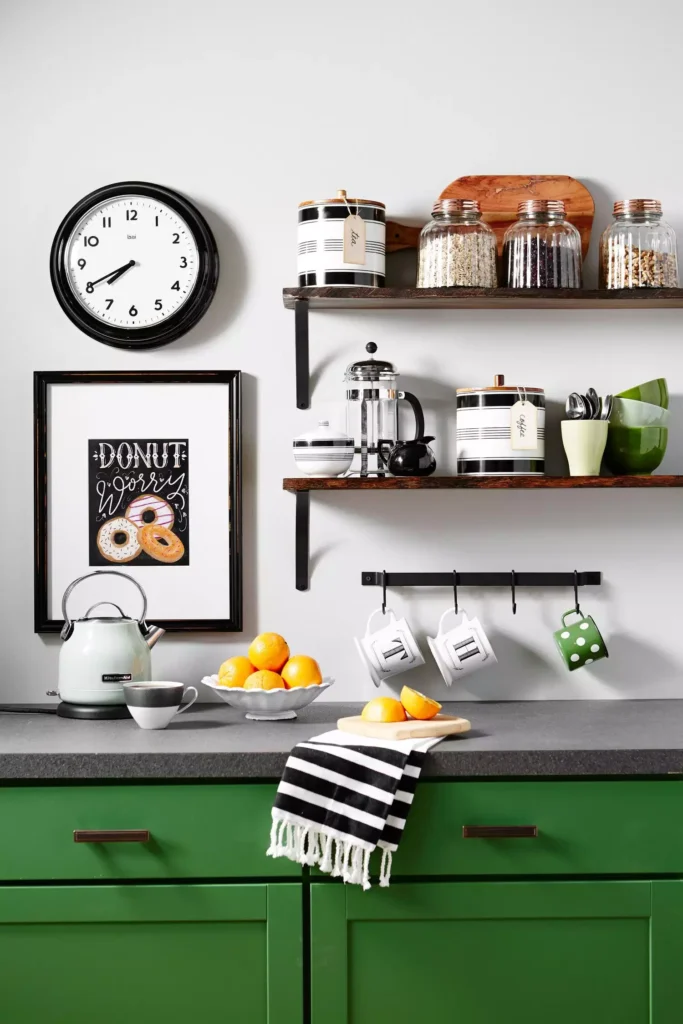
A small framed donut-themed print brings a bit of humor to this kitchen wall, but it is not left hanging by itself.
A black clock and two long wooden shelves fill out the wall around it, with mugs, jars, bowls, and other kitchen pieces providing most of the texture.
The bright green cabinetry underneath gives the whole setup far more personality than a neutral background would.
A Tall Plate Rack That Uses the Whole Wall
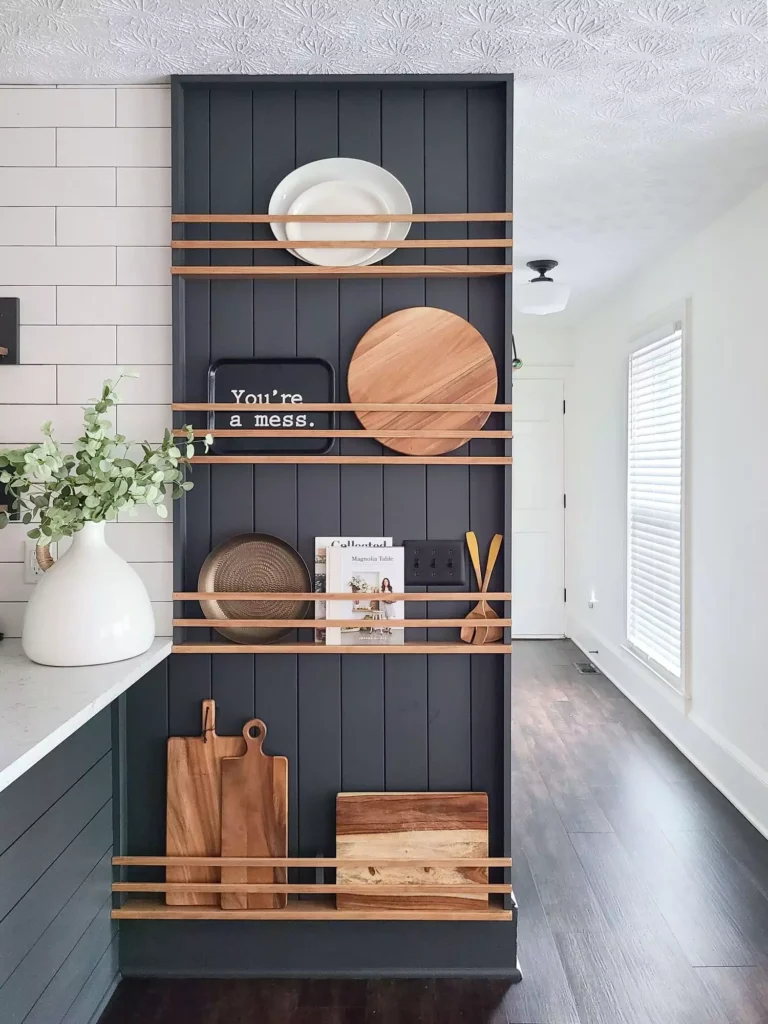
This dark navy plate rack stretches almost from counter height to the ceiling, making storage part of the room’s architecture.
White plates, wooden boards, books, and smaller kitchen objects occupy the different levels. Because the rack itself is so dark, the pale dishes stand out clearly against it.
The lower slots are especially useful for large boards, which would otherwise take up quite a bit of cabinet space.
One Dark Framed Print Above Subway Tile
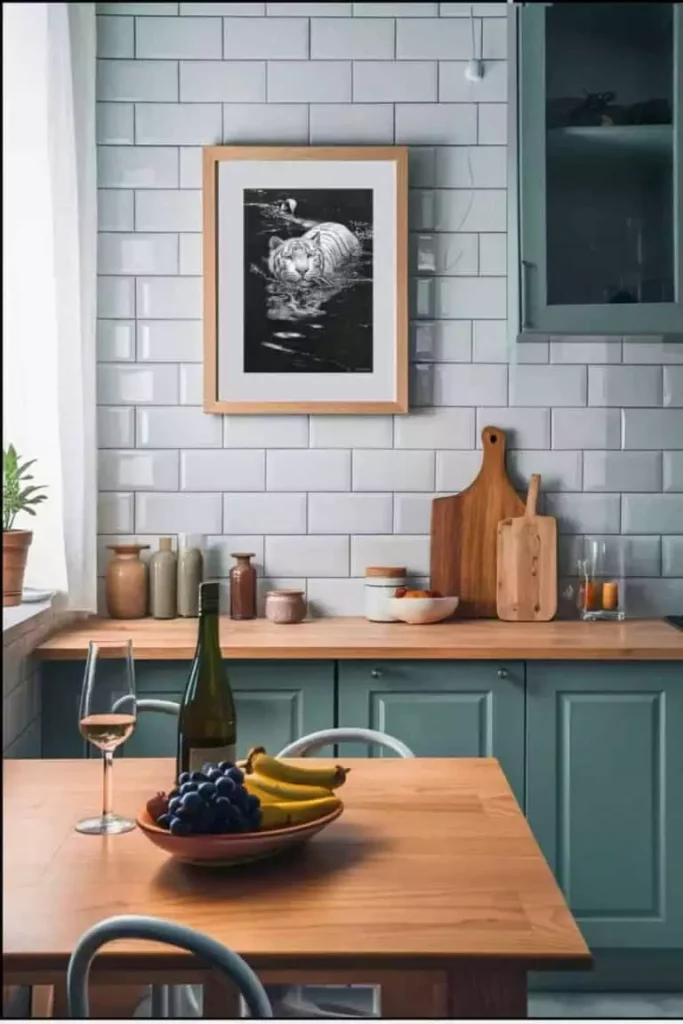
A single black-and-white animal print hangs above glossy white subway tile, surrounded by soft green cabinetry.
There is no gallery and no cluster of accessories competing with it. The warm wood frame is enough to separate the darker image from the cool tile behind it. Sometimes one properly scaled piece really is enough.
A Bright Red Frame on White Brick
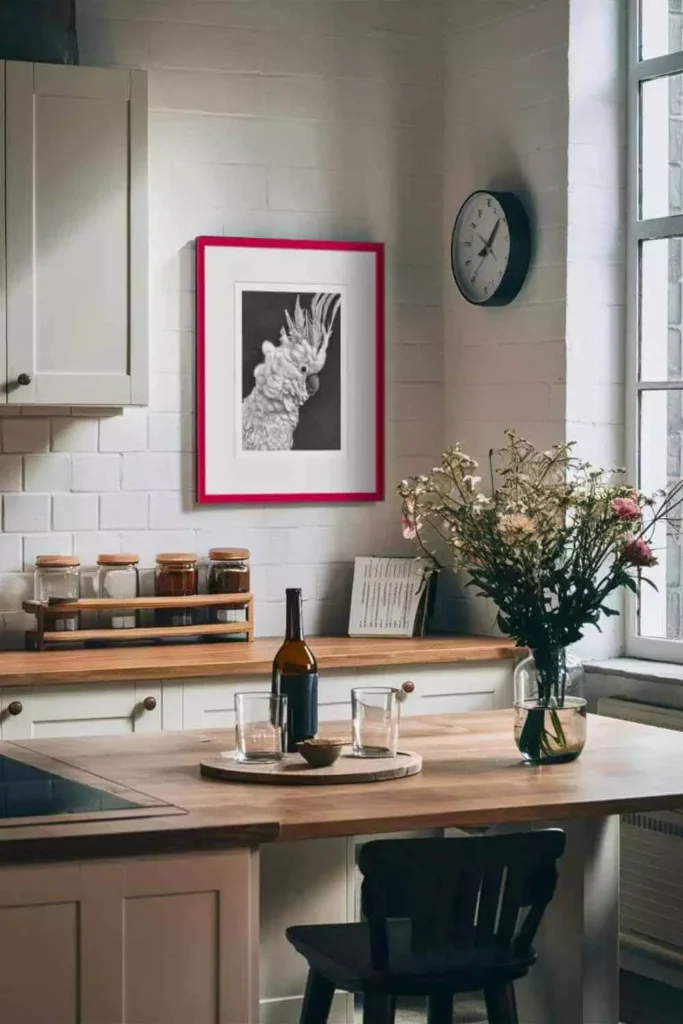
A vivid red frame immediately catches the eye against this pale brick wall.
Inside it is a monochrome pineapple image, so most of the color comes from the frame rather than the artwork itself. A small round clock sits nearby, while flowers and kitchen pieces add softer details below.
The red is used in one concentrated spot, which gives the wall energy without requiring a whole red color scheme.
A Full Grid of Framed Family Recipes
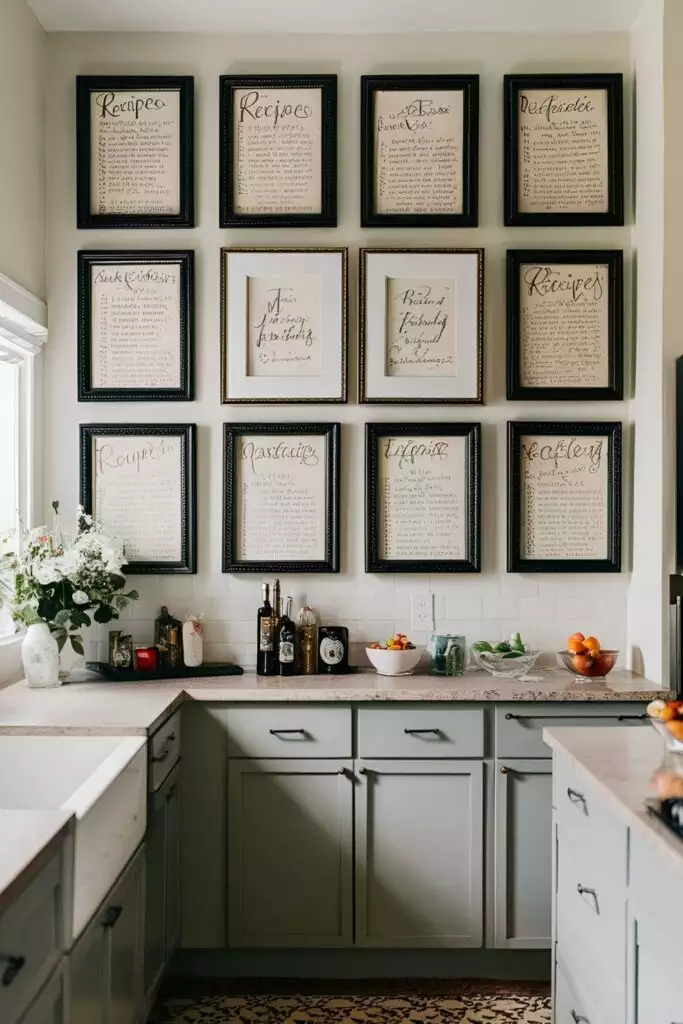
This wall turns handwritten recipes into a large, structured gallery.
Twelve dark frames are arranged in a neat grid above the counters, and each one contains a different recipe or handwritten page. The consistent framing keeps the display orderly even though every sheet inside is different.
There is something especially fitting about keeping family cooking notes on a kitchen wall. They work as decoration, but they still feel connected to what the room is actually used for.
Two Vintage Signs Above the Worktop
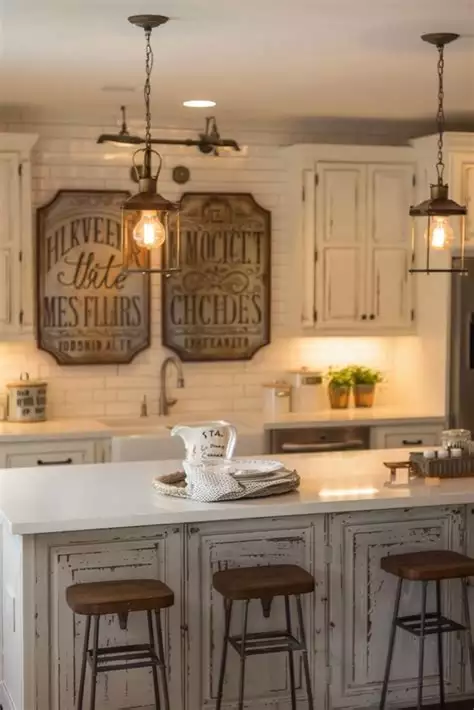
Two large distressed signs sit side by side above the counter in this pale farmhouse-style kitchen. Their aged surfaces and muted lettering suit the warm lighting, wooden boards, and traditional cabinetry around them.
The pair fills a fairly wide stretch of wall without needing lots of smaller pieces around it.
Distressed Metal Signs Against White Shiplap
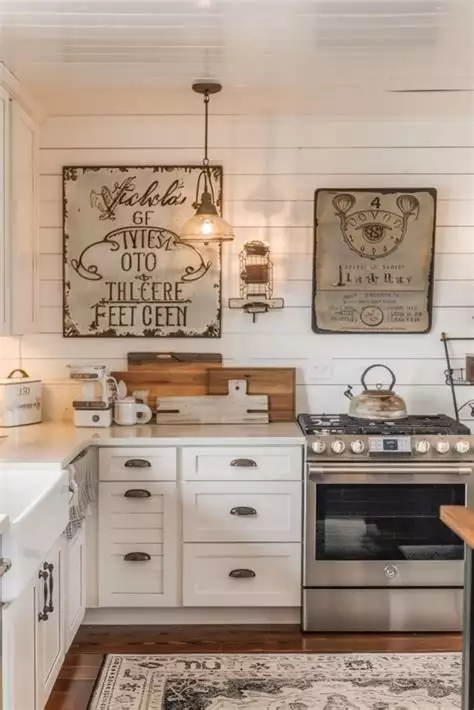
Two weathered metal signs give this white shiplap wall a darker, more industrial accent.
Their irregular aged finishes stand out nicely against the clean horizontal boards. Because the signs are already visually busy, the wall around them stays fairly open. That balance keeps the display from becoming too heavy.
An Oversized Clock Above the Counter
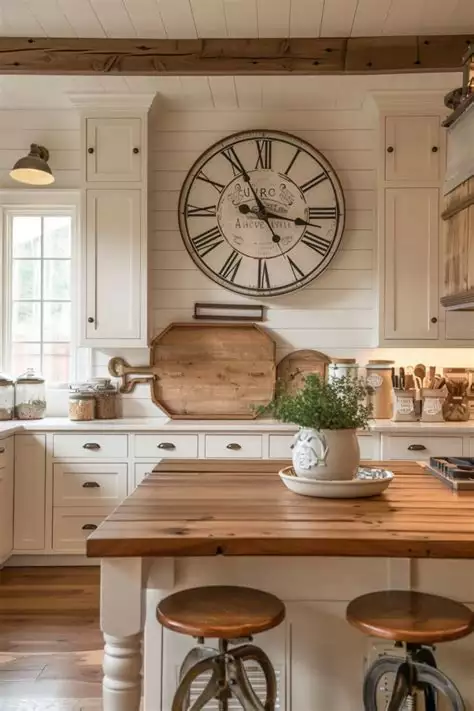
A very large Roman numeral clock becomes the clear focal point of this kitchen.
It sits centrally on the pale paneled wall, with warm wood boards and neutral cabinetry underneath. There are other objects around the counter, but nothing on the wall competes with its scale.
The clock is doing the job that a large piece of art would normally do, while still being useful.
Woven Baskets Wrapping Around a Door
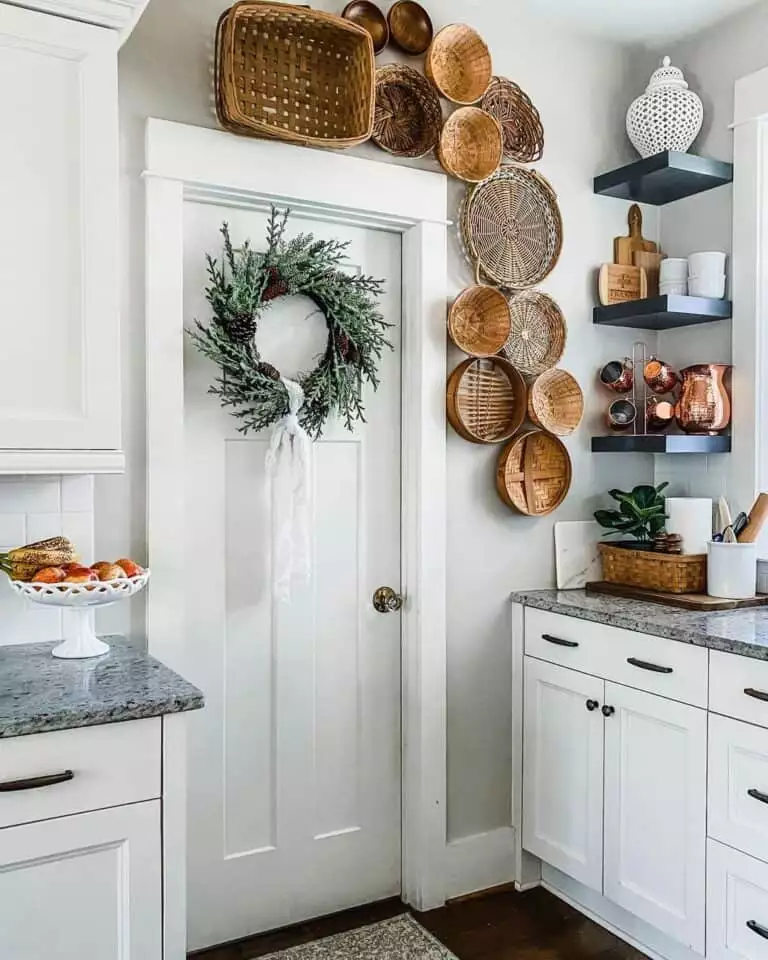
Instead of centering decoration on an empty wall, this kitchen uses the narrow space above and beside a doorway.
Woven baskets in different sizes and patterns climb up one side and continue across the top. Their natural colors bring warmth to the white cabinetry and pale walls.
The mix of round, oval, and rectangular shapes keeps the cluster loose rather than making it feel like a formal gallery.
Wood Paneling With Plates and Hanging Utensils
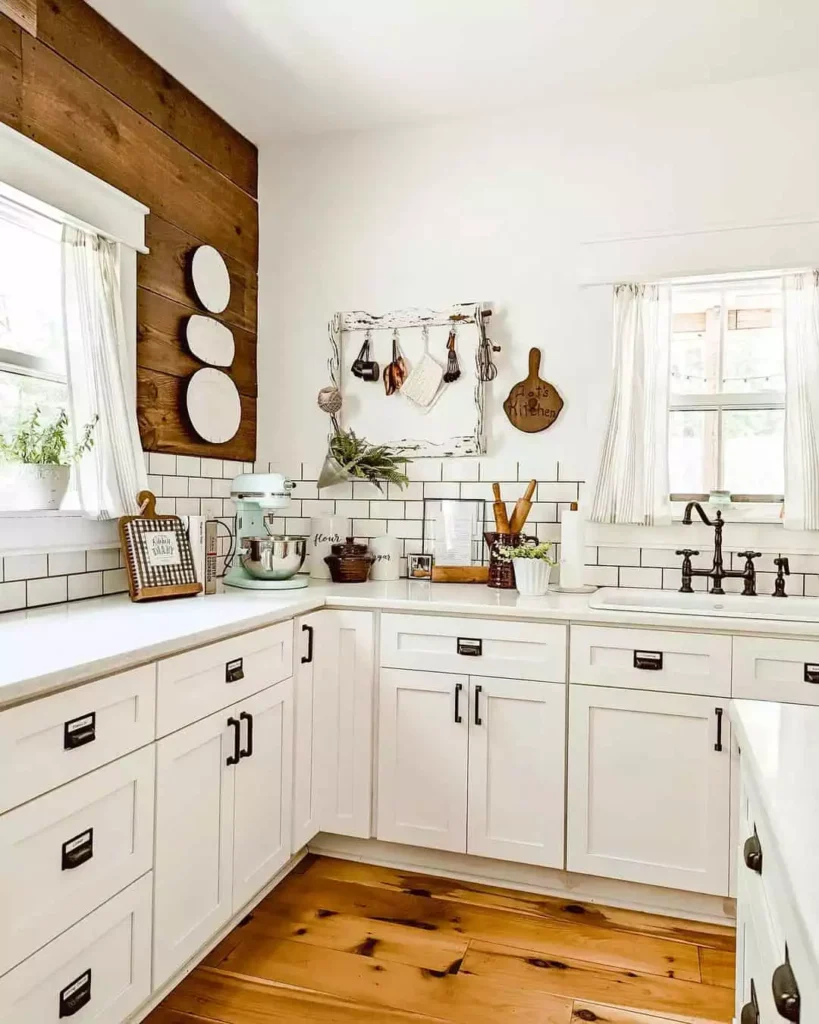
A tall strip of warm wood turns one part of this white kitchen into a strong accent wall.
Three white plates are mounted vertically against the darker timber, so their simple shapes stand out immediately.
On the neighboring white wall, a black rail holds utensils and cutting boards. Together, the two areas show how everyday kitchen pieces can become part of the wall rather than disappearing into drawers.
Patterned Tile Behind Open Wood Shelves
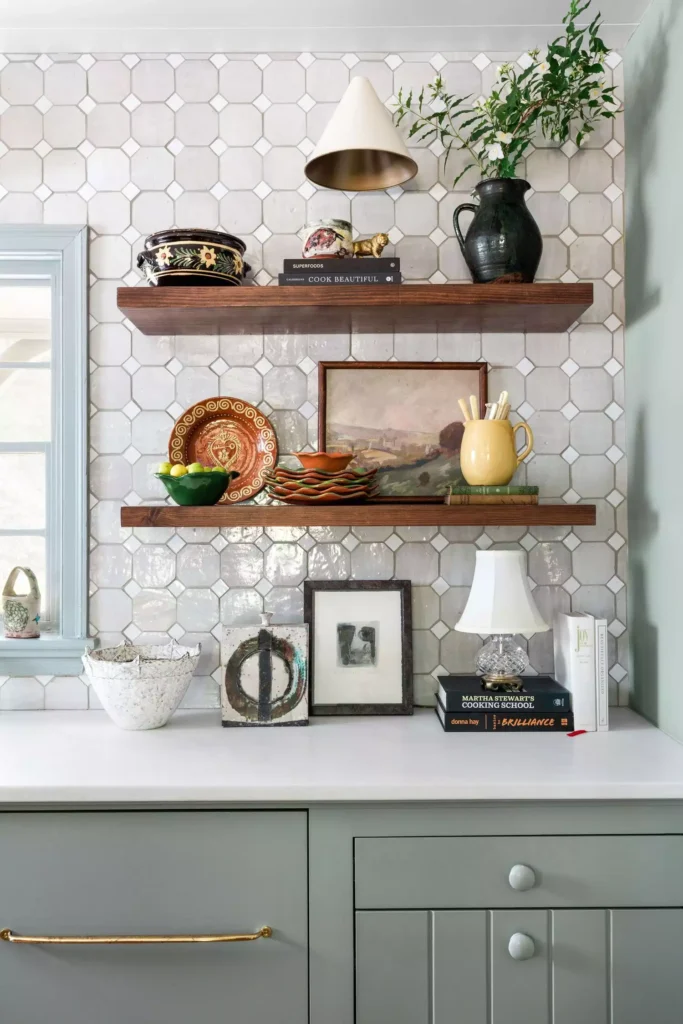
The wall treatment is already doing plenty here. Pale patterned tile covers the background, giving the entire display a soft repeating texture.
Two thick wooden shelves sit in front of it with plates, framed art, books, bowls, and greenery.
There are quite a few objects on the shelves, but the warm wood gives them a clear horizontal structure. Without that strong line, the patterned wall and accessories could easily become too busy together.
A Market Sign Over Open Shelving
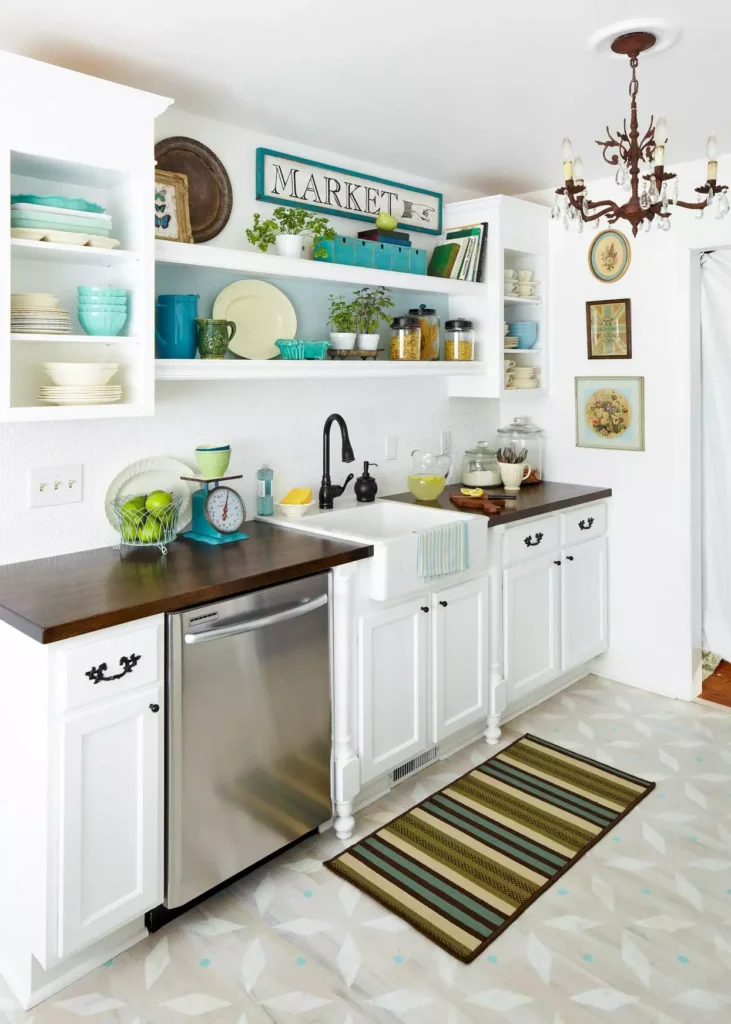
A large MARKET sign sits above long open shelves filled with turquoise dishes, white ceramics, glassware, and plants.
The sign is not isolated from the rest of the wall; it feels like the top layer of a much larger display.
The turquoise pieces scattered across the shelves are what give this mostly white kitchen its character. Even small objects become noticeable when the same color appears repeatedly.
Citrus Art, a Wire Shelf, and a Lemon Wreath
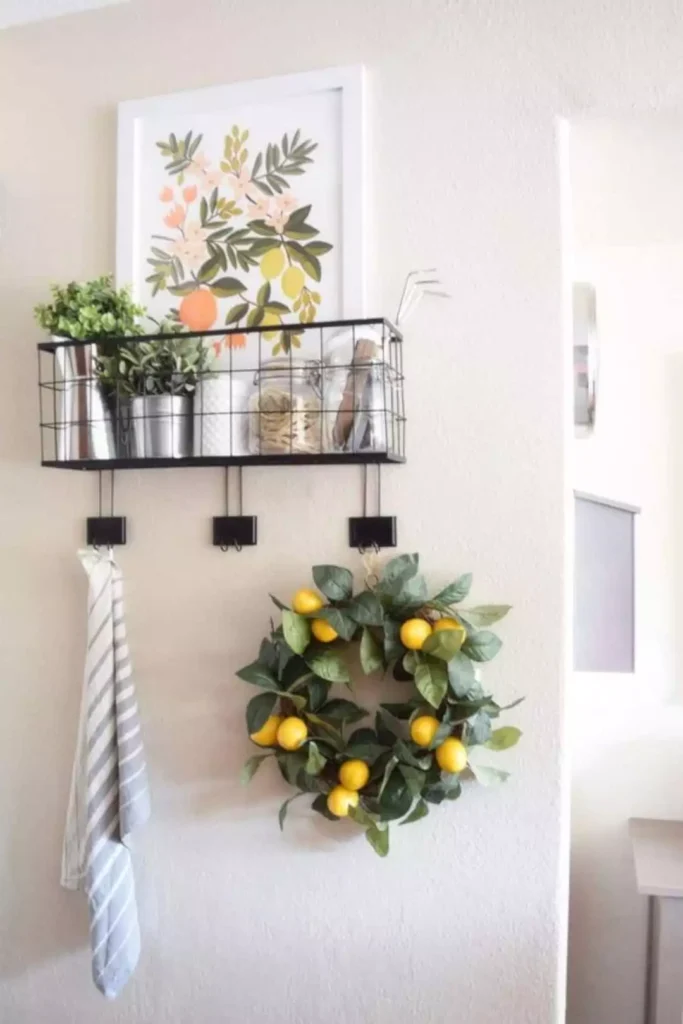
This small wall goes all in on citrus without covering every inch. A botanical-style citrus print sits at the top, with a black wire shelf below holding several small containers. A lemon wreath hangs underneath and carries the yellow-and-green palette farther down the wall.
Because the three pieces are stacked vertically, the arrangement fits into a fairly narrow area.
Cutting Boards Hung From Black Rails
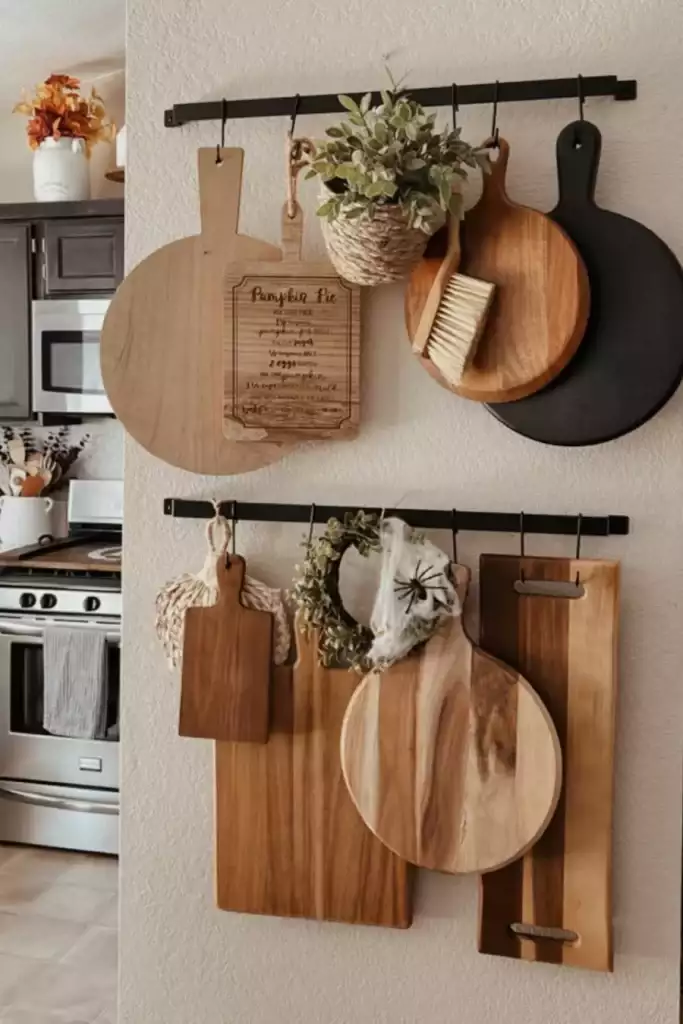
Two black rails turn a collection of cutting boards into a wall display.
The boards vary in shape, size, and wood tone, with a few darker pieces mixed among the lighter ones. Small bunches of greenery soften the arrangement and break up all those hard edges.
It feels practical because these are objects that belong in a kitchen, but the way they are grouped makes them decorative too.
A Giant Gold Flower on a Marble-Look Wall
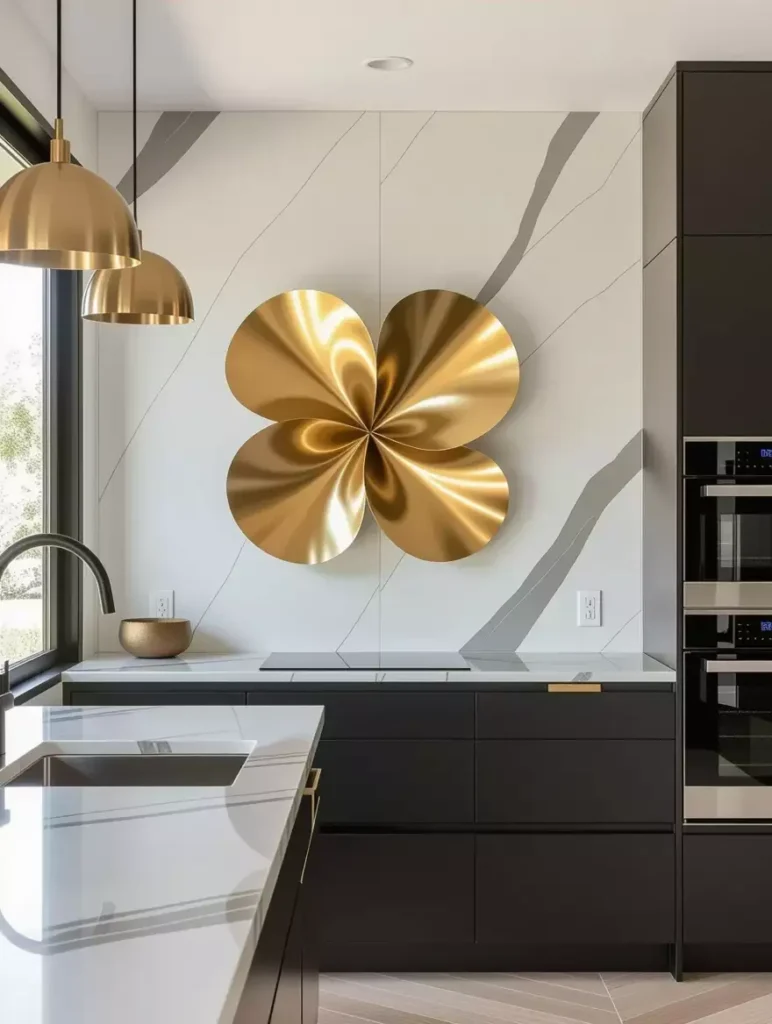
One oversized gold flower is enough to carry this sleek kitchen wall.
Its folded metallic petals catch the light and cast their own shadows, giving the piece much more depth than a framed print would have. The pale marble-look background keeps the focus on the sculpture.
Dark cabinetry below adds contrast without interfering with it. This is one of the clearest examples in the article of letting a single dramatic object have the whole wall.
Pressed Flowers Beside the Sink
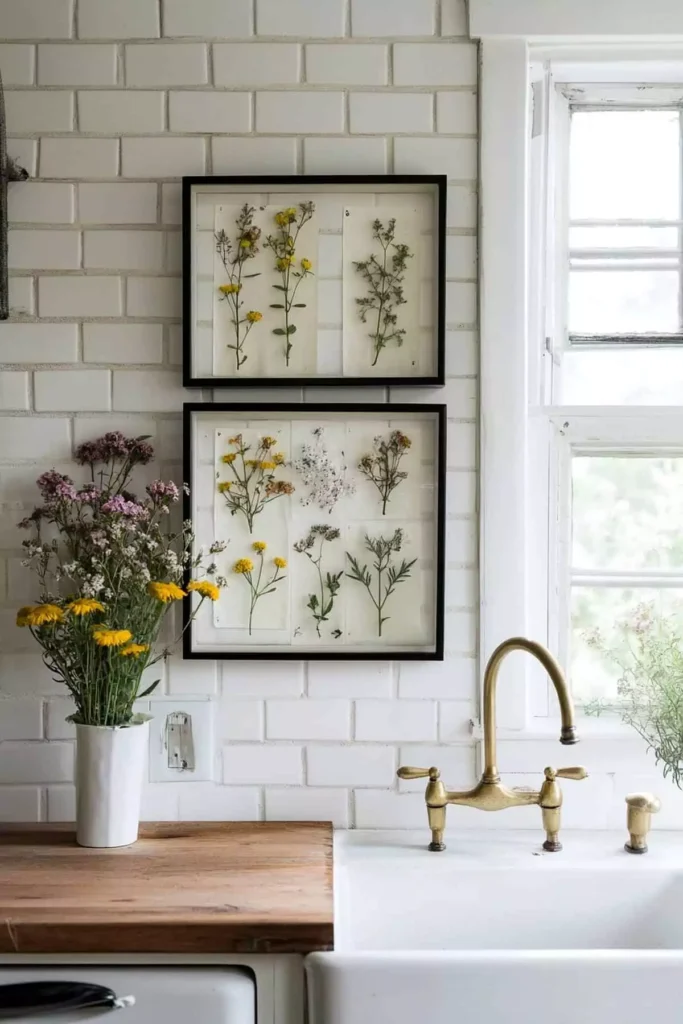
Two framed pressed-flower displays hang vertically on the white brick wall beside the sink. The delicate stems and small blossoms echo the fresh flowers sitting on the counter nearby, but the framed pieces are much quieter.
Slim dark frames help define the botanical details against the white brick without making the display feel heavy.
Six Frames Built Around Food and Drink
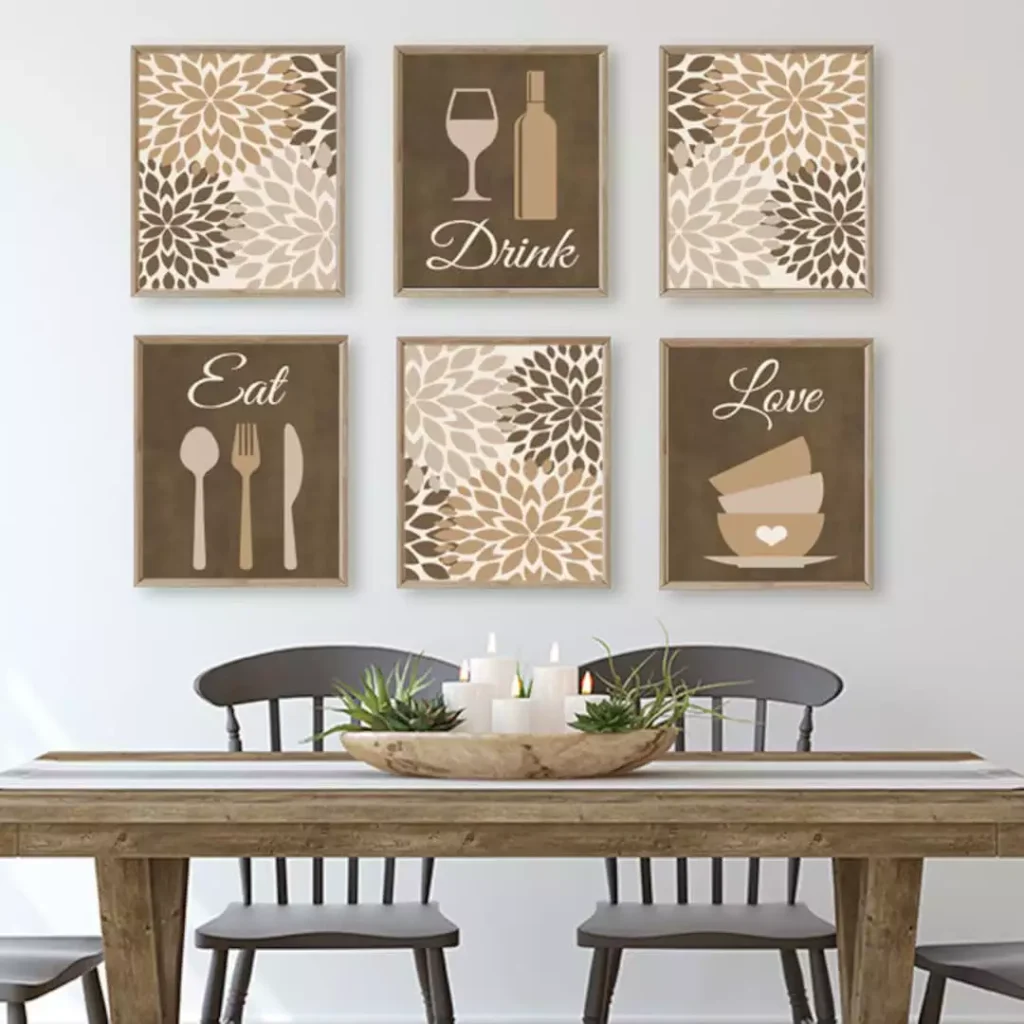
Six matching frames form a tidy rectangular arrangement above the dining table. Words and simple graphics related to eating, drinking, and love alternate with decorative floral-style patterns. The repeated brown-and-cream palette makes all six read as one composition.
Because the grid is so symmetrical, it feels much more structured than the looser gallery walls elsewhere in the article.
Three Different Prints Above a Farmhouse Sink
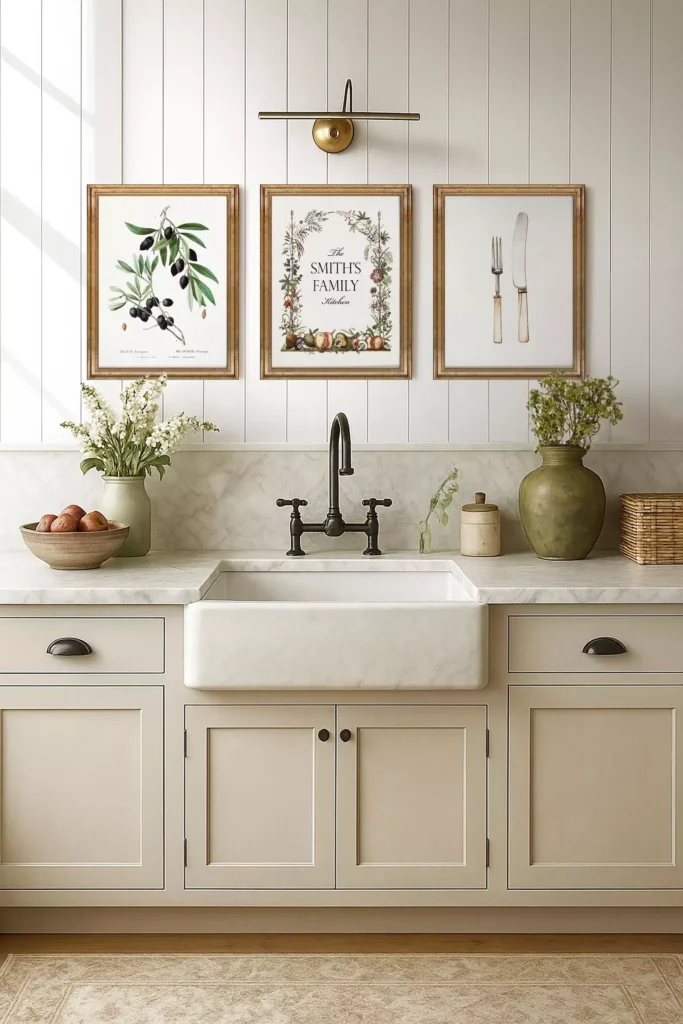
Three framed pieces hang in a row above this farmhouse sink, but they are not identical botanical prints.
One uses leafy imagery, the center carries text, and the third includes a simple utensil illustration. Matching wood-toned frames are what make the different subjects feel connected. A slim brass light above the middle frame gives the trio another strong horizontal anchor.
A Bright Floral Diptych Over White Brick
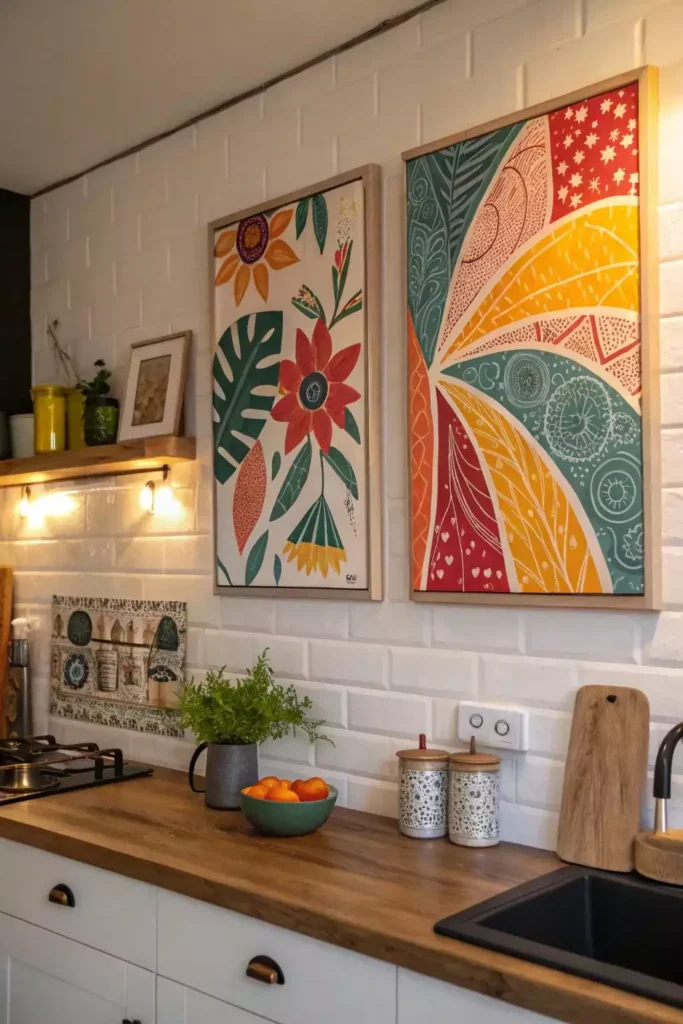
Two colorful floral canvases sit side by side above a long kitchen counter. Both pieces use similar saturated reds, greens, orange, and turquoise, so they clearly belong together without being identical.
The white brick wall gives those colors plenty of contrast, while the warm wood countertop below keeps the whole area from feeling too stark.
Olive Paneling Behind Everyday White Dishes
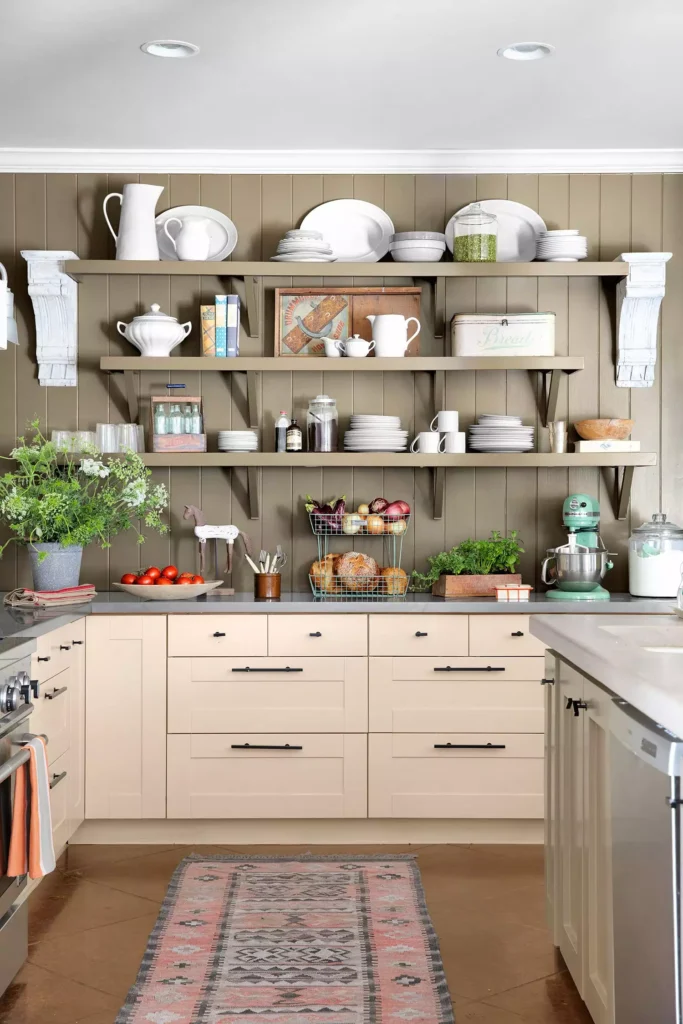
Deep olive paneling turns an entire kitchen wall into a rich background for open shelving.
Three long shelves are filled mostly with white plates, bowls, cups, and glassware. Plants and a few warmer objects are mixed in, but the dishware remains the main feature.
The pale dishes almost read like wall decor because of how strongly they contrast with the green behind them. This is a good example of wall color and storage working together instead of being treated as separate design decisions.
A Cotton Wreath Between Two Rustic Shelves
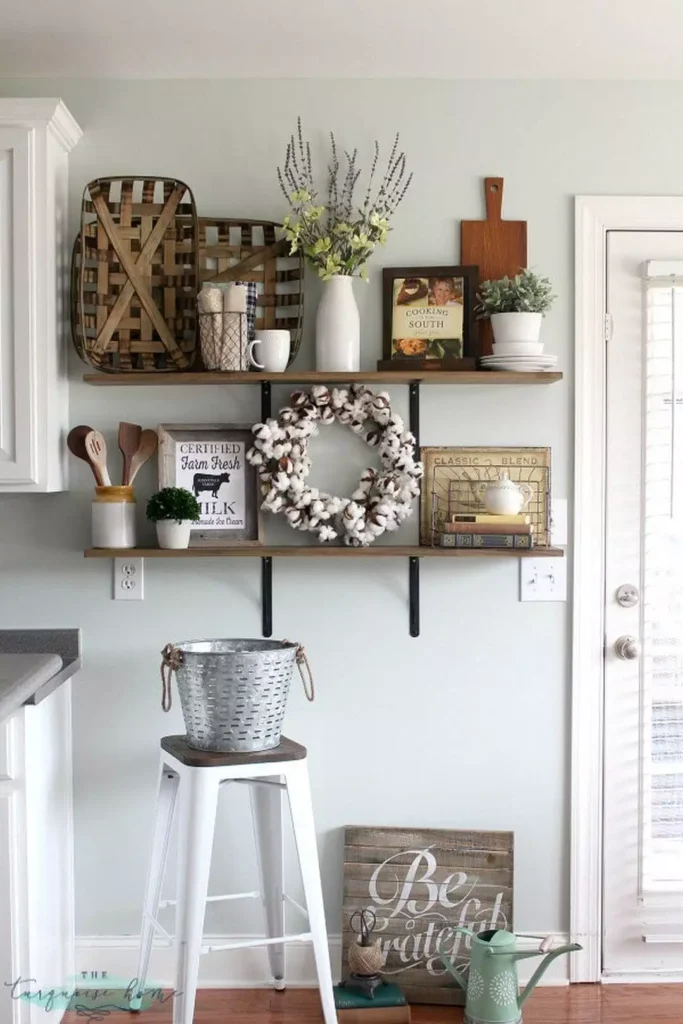
Two wood shelves create a compact farmhouse display on a plain white wall. Baskets, small signs, containers, greenery, and pale decorative pieces fill the shelves, while a cotton wreath becomes the centerpiece between them.
There is a fair amount packed into this small area, but the repeated natural browns, whites, and greens keep it coherent.
Four Black-and-White Typography Prints
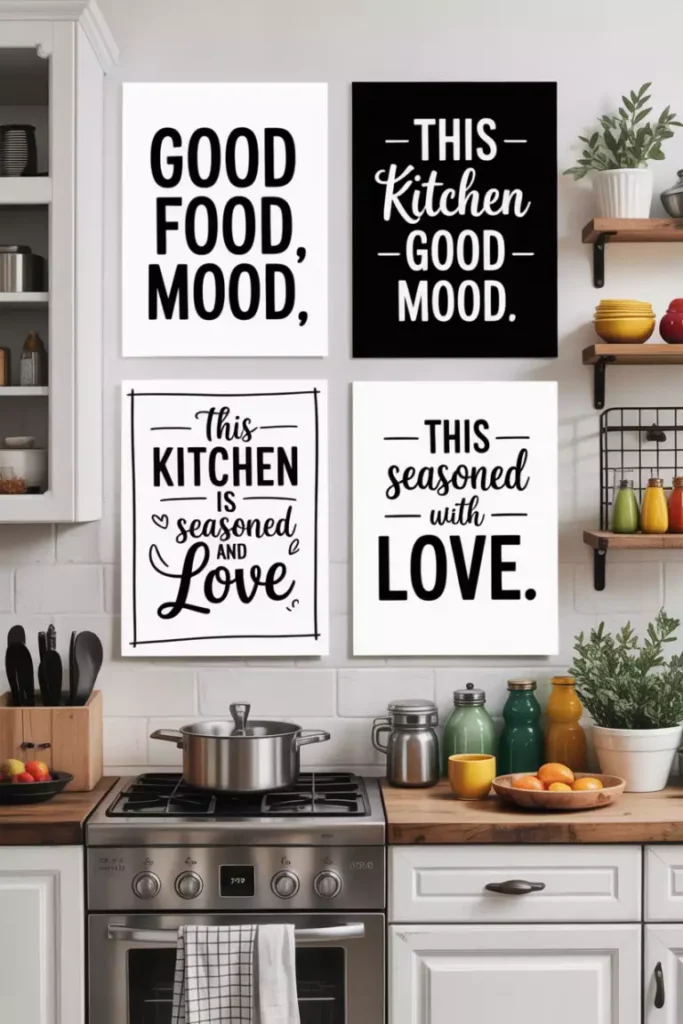
Four oversized typography prints form a clean two-by-two grid above the stove. Black lettering on white backgrounds gives the arrangement a strong graphic quality, especially against the otherwise pale kitchen.
Rather than adding more small decorations around them, the wall lets the grid stay large and simple. The greenery and colorful food on the counters provide enough contrast below.
A Landscape Painting Between Two Sconces
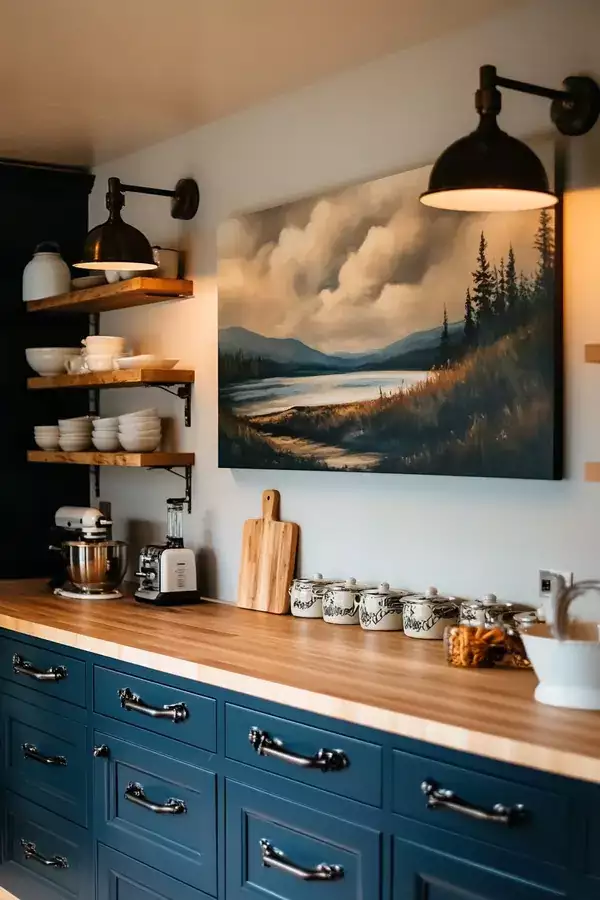
A large landscape painting hangs above a deep blue kitchen counter, framed by two black wall sconces.
The artwork brings soft blues, greens, and earthy tones into an area dominated by dark cabinetry. Warm light from the sconces makes the wall feel almost like a small gallery display.
Open shelves on either side carry dishes and kitchen objects, but the painting remains the visual center.
Floral Wallpaper With a Portrait Layered Over It
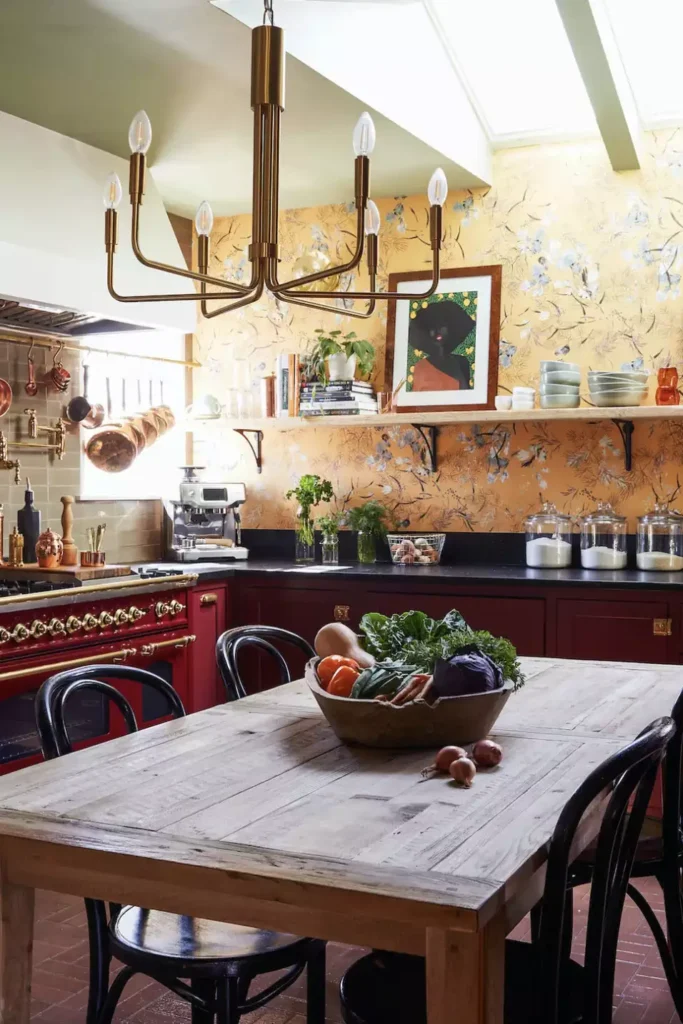
This wall already has plenty of pattern before the framed art is added.
Floral wallpaper stretches behind the cooking area and across the upper wall, bringing warm yellow, blue, and green tones into the kitchen. A single framed portrait sits over the pattern instead of trying to cover it.
The open shelf below holds cookware and plants, creating another visual layer underneath. There is a lot going on, but the wall feels intentionally full rather than unfinished.
Abstract Wood and Metal Wall Sculpture
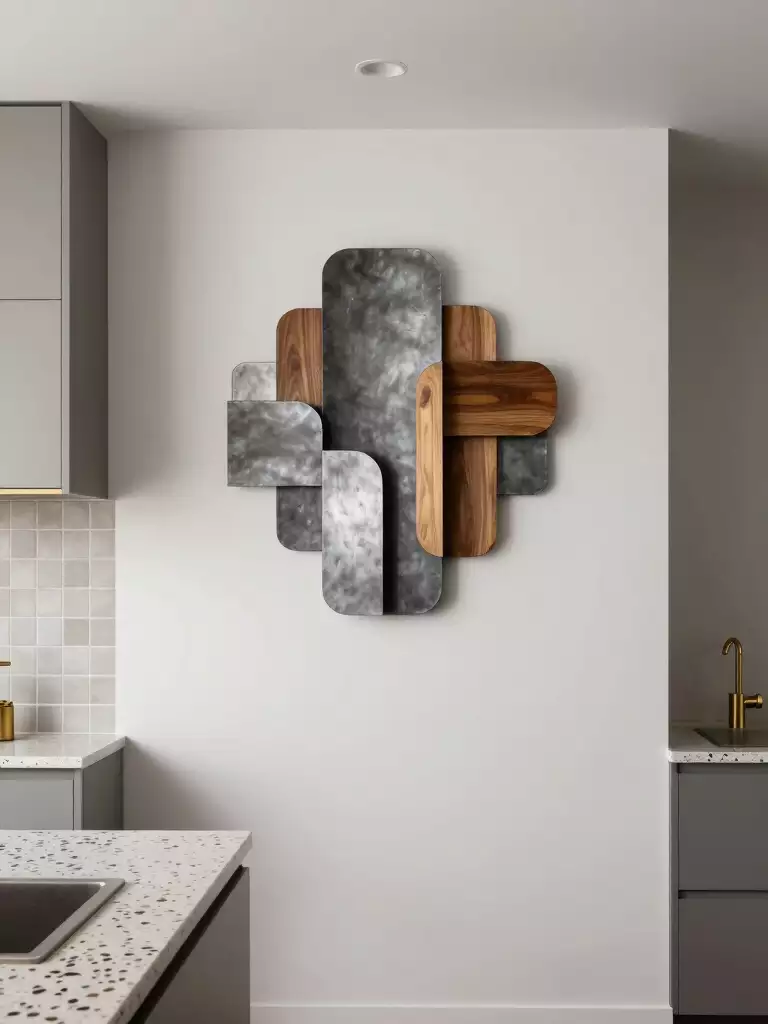
Several overlapping panels of wood and dark metal create a sculptural composition on this otherwise plain wall. Different heights, widths, and finishes give the piece depth even though the palette stays restrained.
With no surrounding gallery or extra wall accessories, the sculpture gets enough empty space to show its shape clearly.
A Wall Covered in Red Plates
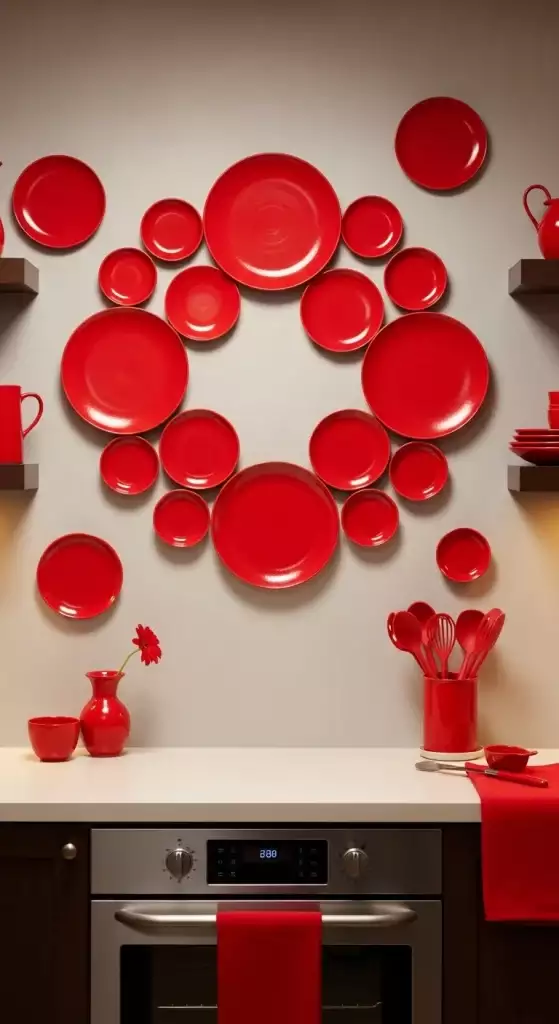
Red plates in many different sizes spread across the wall above the oven.
Some sit close together while others leave small pockets of white wall visible, so the arrangement feels energetic instead of rigid. Matching red utensils and accessories below carry the color into the kitchen itself.
The plates are ordinary objects, but using one strong color in such a large group turns them into something much more graphic.
A Wall of Herbs Beside the Window
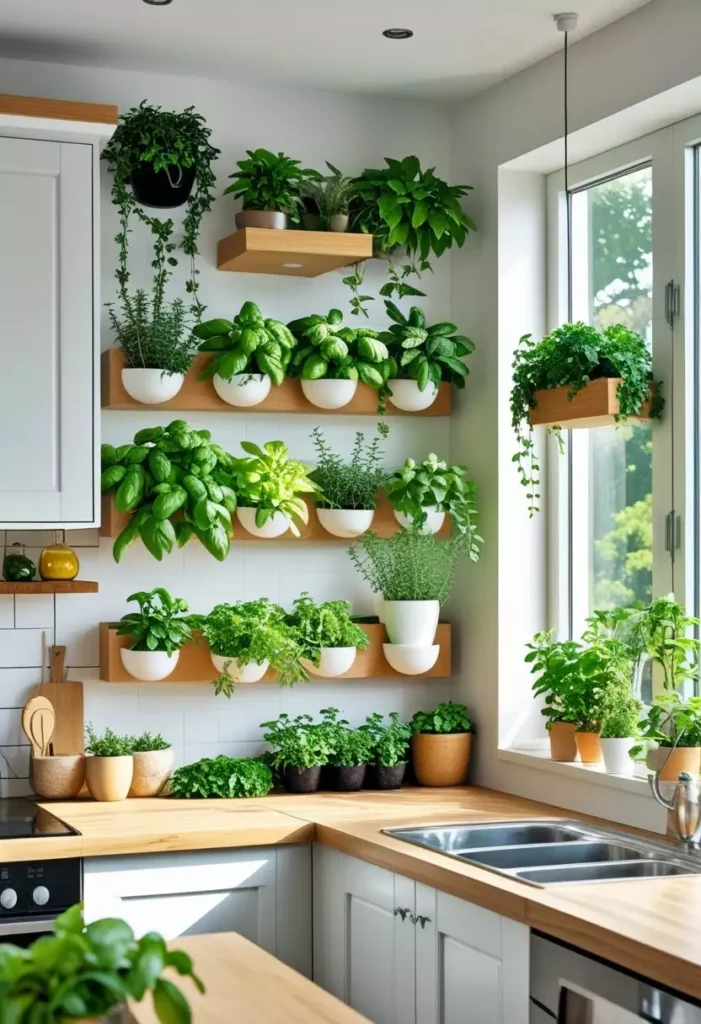
Wooden shelves cover most of this bright corner wall, each one packed with pots of herbs and leafy plants.
The window beside them gives the greenery plenty of natural light, and vines from the upper levels trail downward between the shelves. Different leaf shapes keep the wall interesting even though nearly everything is green.
This display is decorative, but it also feels completely at home in a kitchen. Instead of adding artwork inspired by herbs, the herbs themselves become the wall.
Wall Decor That Belongs in the Kitchen
What stands out across these rooms is how often the strongest wall decoration comes from something that already belongs in a kitchen. Plates, cutting boards, recipes, shelves, utensils, herbs, clocks, and dishes can all become part of the visual story when they are arranged with a little intention.
Then there are the walls that go in the opposite direction: one giant metal flower, bright wallpaper, a landscape painting, a lemon-covered arch, or a dramatic collection of red plates. Those pieces work because they are allowed enough space to matter.
A kitchen does not need decoration on every free wall. The better question is what that particular wall can handle—something useful, something personal, or one piece that simply makes the room more interesting.