
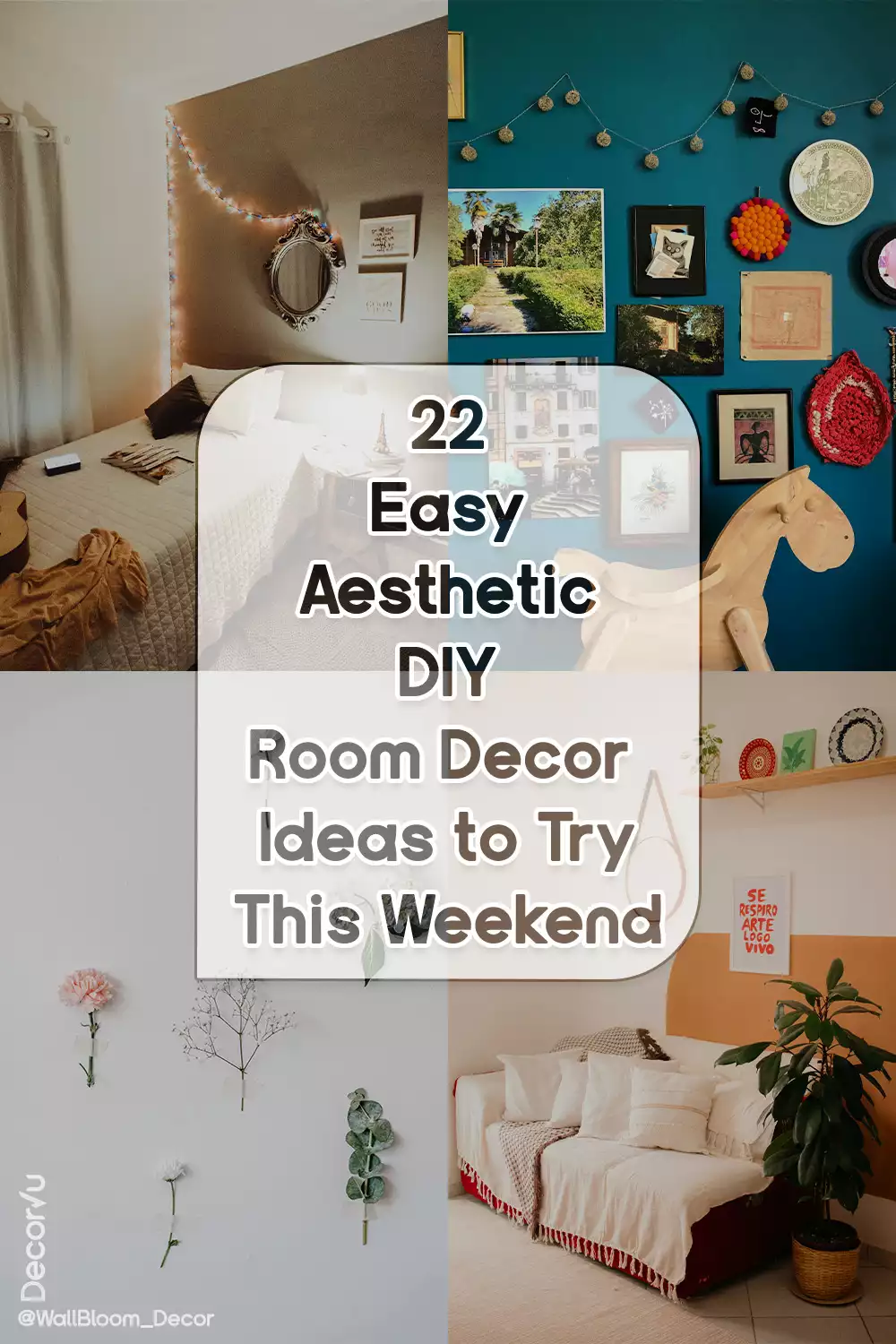
DIY room decor doesn’t have to mean filling every wall or starting a complicated craft project. A string of lights, a few clipped prints, trailing greenery, paint, or one handmade hanging can be enough to change how a corner feels.
The ideas below use different amounts of wall space and different levels of commitment. Some can be changed whenever you like, while others use paint or larger arrangements. Look at the shape of your wall, the light in the room, and what you already own before choosing where to start.
A Macrame Crescent Moon Wrapped in Fairy Lights
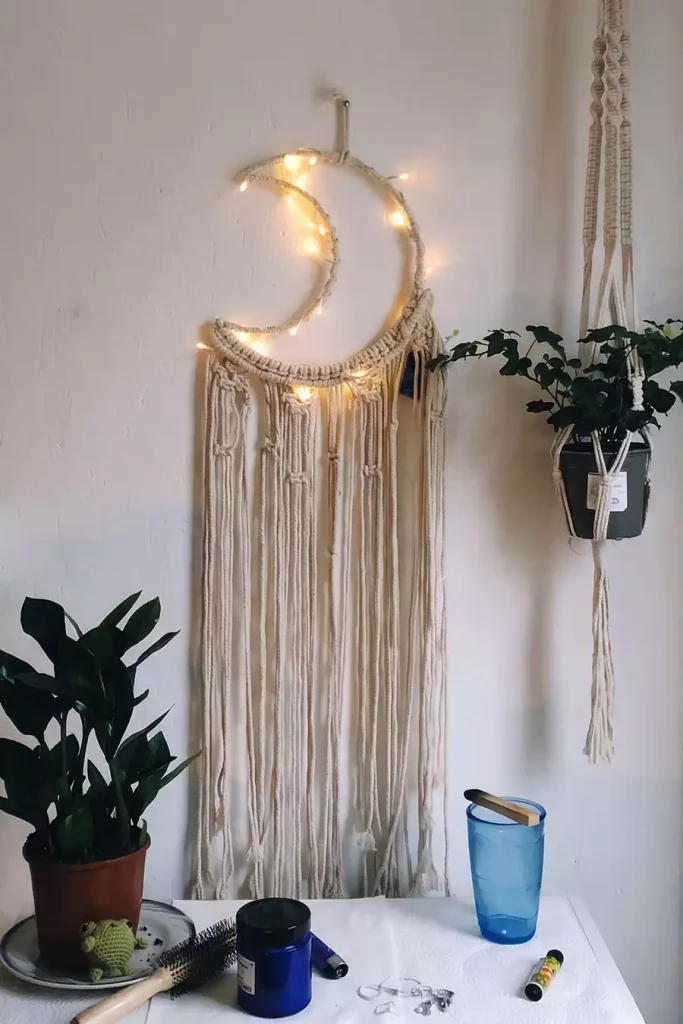
The fairy lights follow the curve of this cream macrame moon instead of simply hanging around it. That makes the glow feel like part of the piece, while the long knotted fringe gives the crescent enough length to fill the wall above the table.
A second macrame hanger with a leafy plant sits nearby, so the moon does not have to carry the whole corner on its own.
If you make something similar, working the light wire into the cord can keep it from becoming the first thing you notice during the day.
Watercolor Prints Around One Bold Black Canvas

A loose collection of pale watercolor prints spreads across this white wall, but the dark rectangular canvas on the left gives the arrangement a much stronger anchor. A second dark circular frame on the opposite side helps carry that contrast across the gallery.
The individual prints vary in size, subject, and orientation, so trying to line them into a strict grid would change the character of the wall.
If you are combining inexpensive prints, postcards, or your own artwork, one or two darker pieces can give a loose arrangement some structure without requiring matching frames.
Colorful Posters Wrapping a Pale Green Corner

Instead of stopping the display at the corner, the artwork continues onto both wall planes. Smaller illustrated prints climb the left side, while larger, brighter posters spread across the wall on the right.
That makes the corner itself part of the arrangement rather than an interruption. The black wall sconce sits among the smaller pieces and is allowed to stay visible instead of being avoided completely.
For a similar setup, think about the two walls together before hanging anything. One side can carry smaller pieces while the other takes the larger artwork.
String Lights Framing a Bedroom Corner

The string lights follow the edge of the room before sweeping toward the oval mirror, so they do more than add glow. They trace the shape of the corner and lead attention toward the main wall piece.
The mirror, two framed prints, and lights occupy the upper half of the wall, while the bedside table and bed stay relatively simple underneath. That keeps the lights from competing with too many other decorations.
If you use string lights this way, let them follow an architectural line such as a corner, beam, or ceiling edge instead of hanging them randomly across the wall.
A Gallery Wall That Follows the Sofa Colors
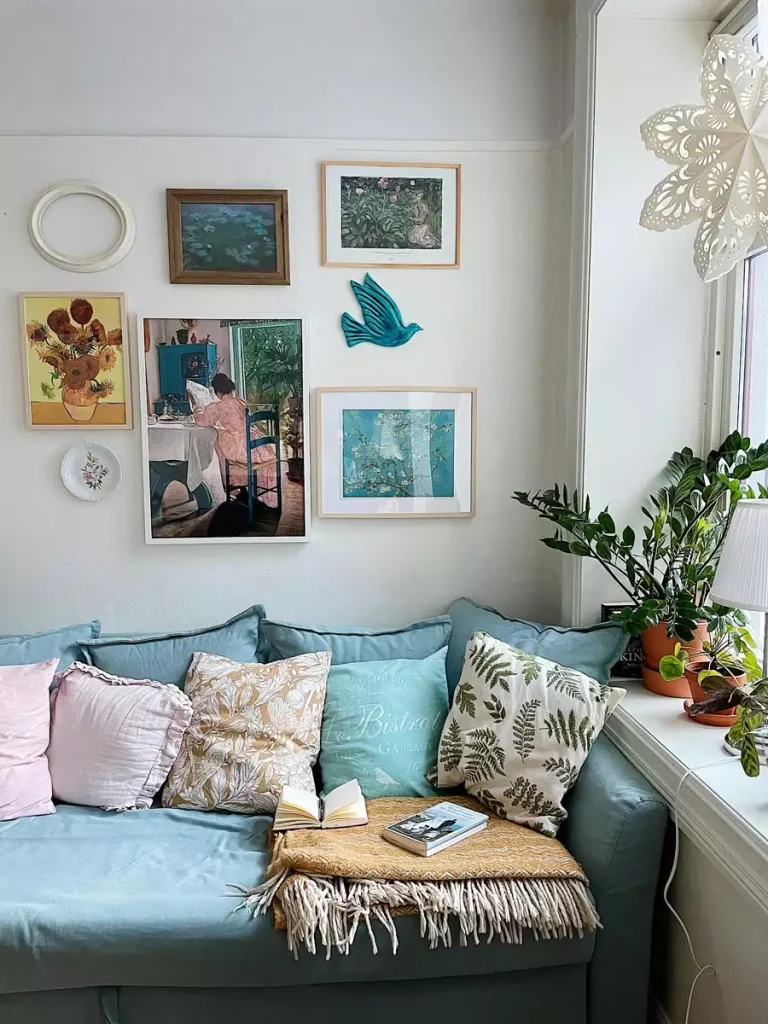
The frames above this blue sofa do not match, but the artwork keeps returning to blues, greens, and softer natural tones already present in the seating area. That shared palette is what lets gold, pale wood, dark wood, and white frames sit together comfortably.
A small teal bird and a floral plate break up the rectangular frames, giving the arrangement a few different shapes.
If you are building a gallery from pieces you already own, repeating a few colors can be more useful than trying to replace every frame with a matching one.
Teal Paint as a Backdrop for Everything You Collect

The deep teal wall gives this mixed collection a strong background. Photographs, framed artwork, a small round mirror, a decorative plate, a beaded hanging, and a simple pom-pom garland all have different shapes, but the dark color behind them keeps the wall from feeling fragmented.
Small red and orange accents stand out especially clearly against the blue-green paint.
A painted wall like this can be useful when you want to display unrelated objects together. The background provides the connection, so the individual pieces do not have to come from one matching set.
A Wire Grid Board for Postcards and Prints

A wire grid gives small prints and postcards a place to live without turning them into a permanent gallery. The cards are clipped rather than framed, so the arrangement can change whenever something new comes along.
The gold-toned grid also connects with the metal details around the desk, while the soft pink textiles keep the workspace from feeling too hard or industrial.
This is one of the more flexible ideas in the article. You can remove one card, add another, or rearrange the whole board without putting new holes in the wall.
Ivy Climbing a White Brick Column
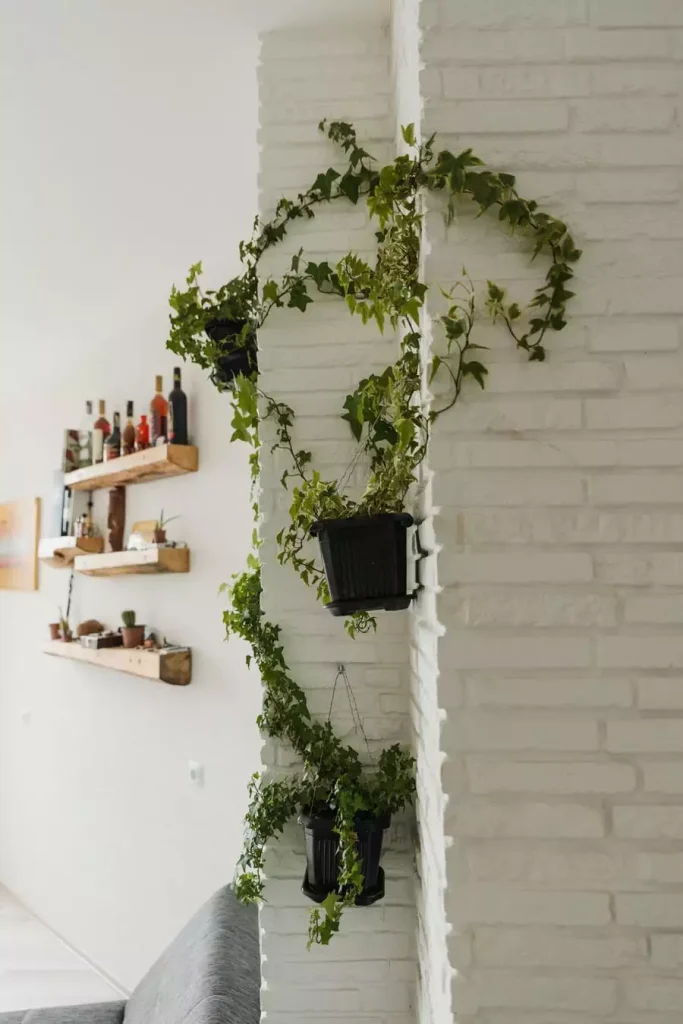
A narrow brick column could easily have been left empty, but the hanging plants use its height instead. Dark planters sit at different levels while the trailing greenery moves down and across the white brick.
The staggered placement prevents the plants from forming one heavy block near the ceiling. This kind of arrangement is worth considering for awkward vertical spaces beside doorways, columns, or wall edges where a wide shelf or gallery would not fit.
Mismatched Prints Under a Wooden Beam
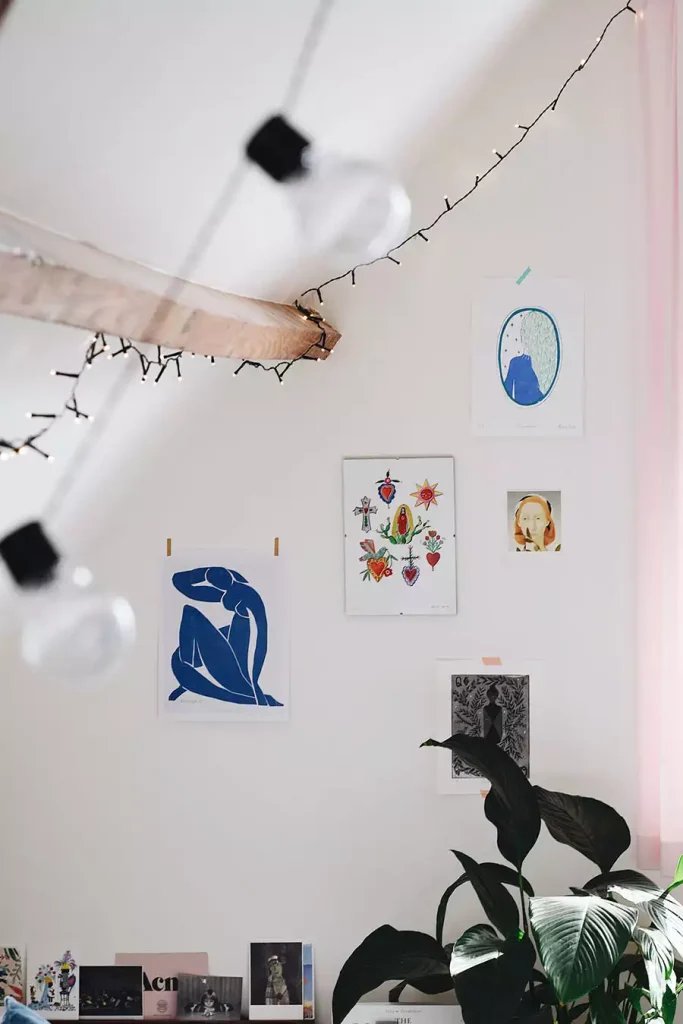
The artwork here follows the character of the room rather than trying to straighten everything out. Prints hang at different heights beneath the wooden beam, while fairy lights trace the structure above them.
Visible clips and small pieces of tape suit the informal display, and the uneven arrangement works with the sloped, attic-like corner instead of fighting it.
If your room has beams, angled ceilings, or other unusual architecture, use those lines as a guide. The artwork does not always need to sit inside a perfect rectangle.
Instruments as Wall Art Above a Cube Shelf
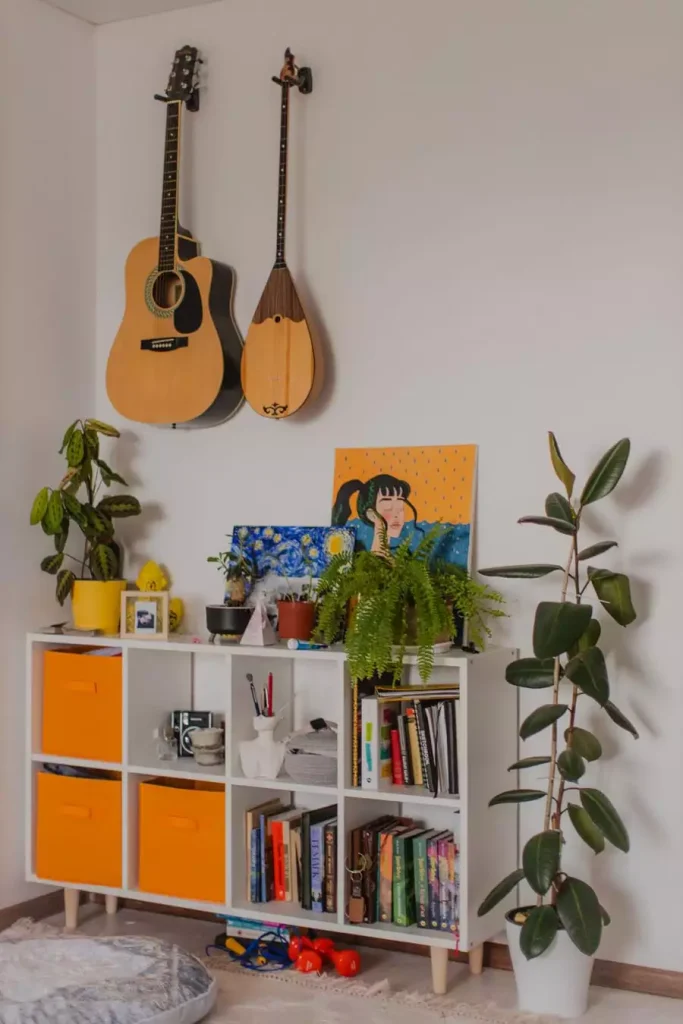
The guitar and long-necked wooden instrument bring two very different silhouettes to the wall. Because both have warm wood tones, they still feel connected even though one is broad and the other much slimmer.
Hanging instruments can also free up floor space or keep them from leaning in a corner when they are not being used.
Below, the cube shelf carries most of the smaller objects and plants, leaving the instruments enough empty wall around them to remain the main feature.
A Tan-Orange Color Block Behind the Sofa

The tan-orange paint does not cover the whole wall. Instead, it rises behind the sofa and ends with a rounded upper edge, creating a large block of color around the seating area.
A round mirror and framed print sit partly within that painted section, while the surrounding white wall keeps the color from becoming too heavy.
This is a useful way to visually frame furniture without painting an entire room. You can adjust the width and height of the color block to suit the sofa or console underneath it.
Half-Painted Wall Behind a Trestle Desk

The horizontal paint line helps define this desk area before any artwork is added. Tan-orange covers the lower part of the wall while the upper half stays white, creating a clear background for the work zone.
Framed pieces and a round sign sit above the desk, while shelves and storage stay close to the workspace itself.
Half-painted walls work especially well when you want color without committing to the whole wall. The important part is deciding where the line should sit in relation to the furniture before you begin.
Faux Vines Hung Like a Green Curtain

Long strands of faux leaves hang from a dark rod across the white wall, creating something closer to a soft green curtain than a single plant display. The strands do not all fall with exactly the same density, which helps the greenery feel less rigid.
If you make a similar wall, vary the strand lengths a little instead of cutting every vine to the same point. That small change can keep the lower edge from looking too mechanical.
A Gold Moon Phase Strand Over a Crystal and Fern Corner
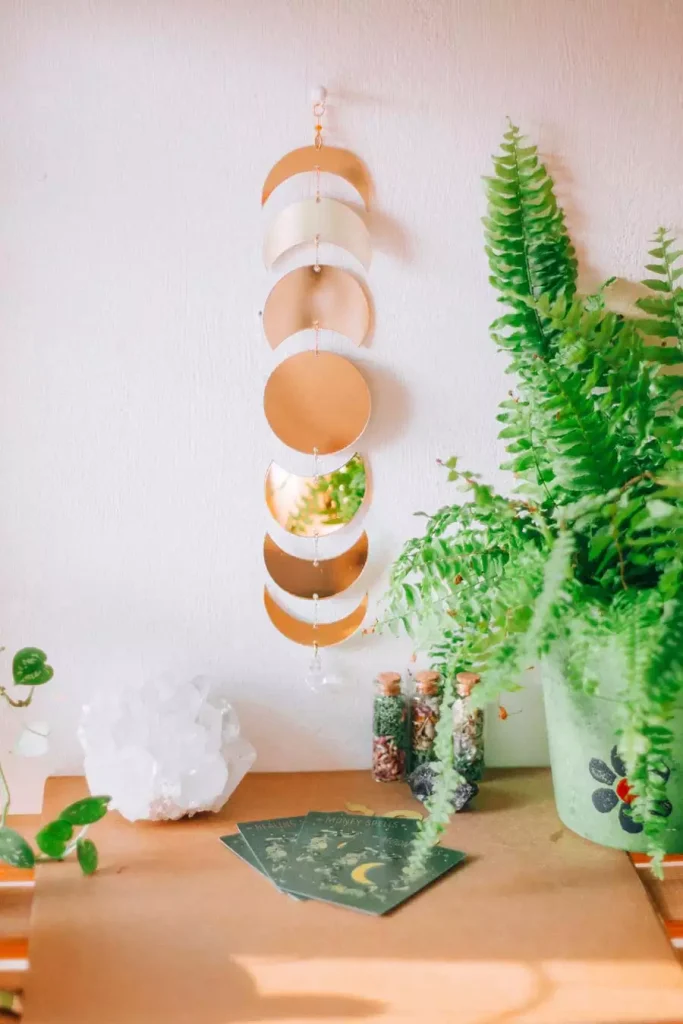
The narrow moon-phase hanging gives this small corner a clear vertical focal point without taking up much wall width. Its gold discs run down the wall above a table holding a crystal cluster, small bottles, cards, and a leafy plant.
Rather than adding several separate wall decorations, the arrangement builds outward from one central hanging. This approach can work well on a slim wall: choose one vertical piece first, then let the objects below repeat its colors or theme.
A Stick Sunburst and a Raffia Ring in Afternoon Light
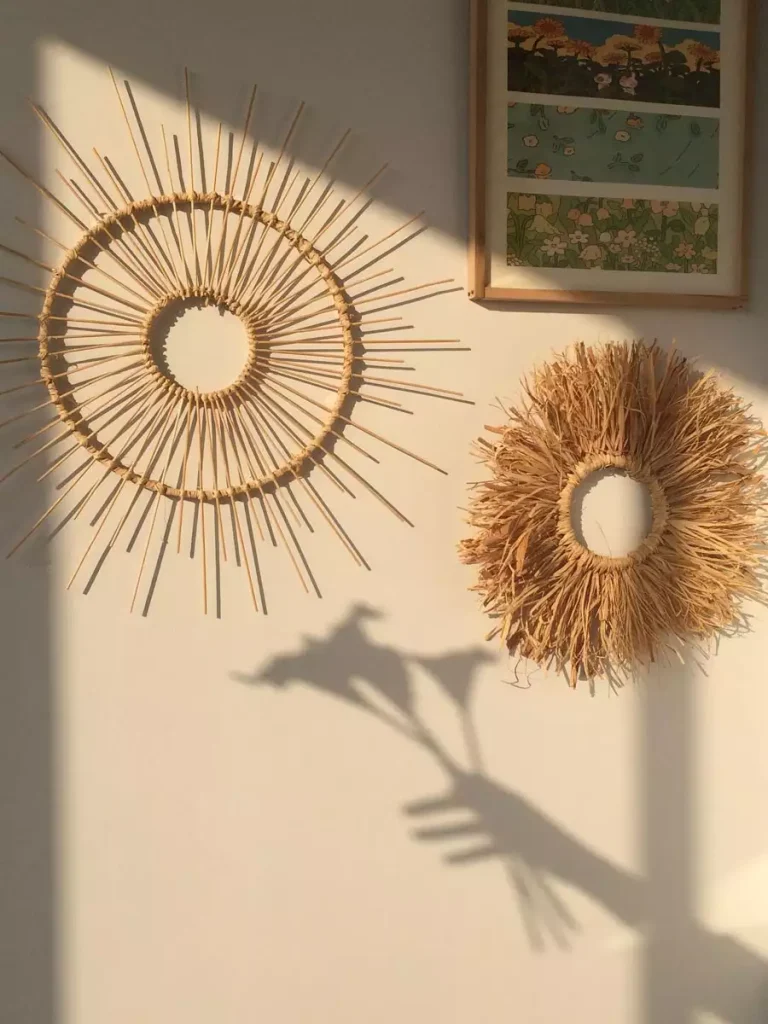
These two handmade pieces use similar natural materials but very different shapes. The stick sunburst is open and spiky, while the raffia ring beside it is softer and fuller.
Sunlight adds another layer by throwing long shadows across the cream wall. The shadows make the thin sticks more noticeable and change as the light moves through the room. If you have textured wall decor like this, placing it where natural light reaches the wall can become part of the effect.
Branch Hanger With Faux Flowers, Tassels, and Clothespins
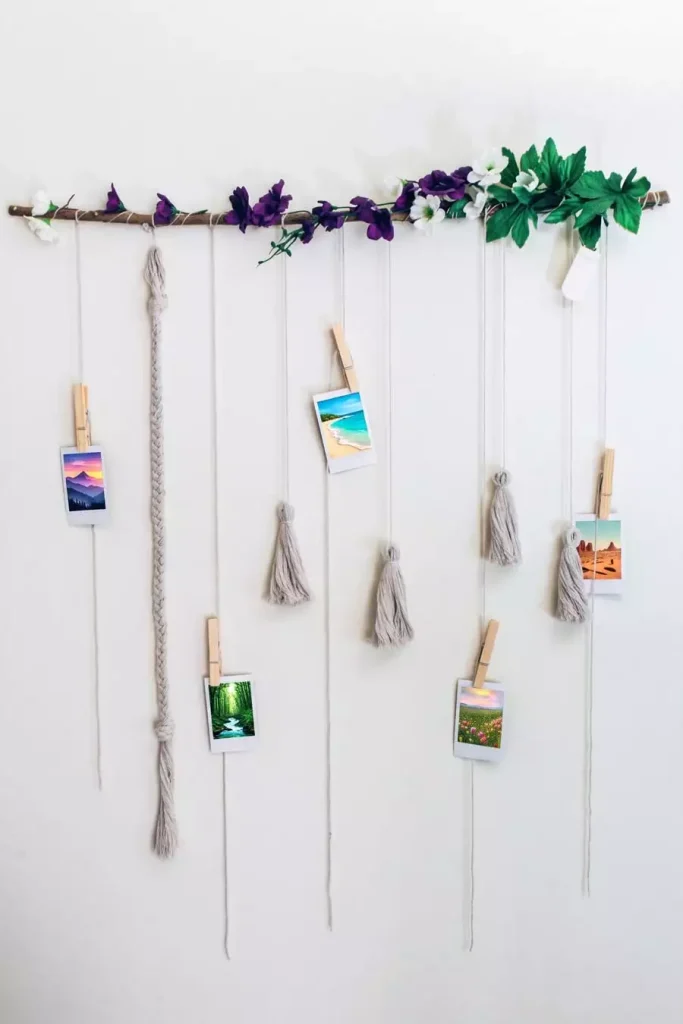
A horizontal branch carries flowers, cords, tassels, and small clipped photographs, but the decorations are not distributed evenly from end to end. The floral cluster sits more heavily on one side, giving the hanging an intentionally off-center shape.
The photographs hang from separate strings at different heights, which keeps them from forming a stiff row.
Because they are held with clothespins, the pictures can be changed without rebuilding the whole piece. That makes this idea useful for travel photos, seasonal images, or small prints you want to rotate.
Macrame Wings on a Weathered Branch

The cream macrame wings have enough shape and texture to fill the wall without needing artwork around them. Their feather-like cords spread outward from the center before tapering into pointed fringe.
The branch above introduces a rough natural line against all that soft fiber. Leaving plenty of empty wall around a large textured piece like this can be more effective than surrounding it with smaller decorations. The space helps the outline remain clear.
Trailing Pothos and Small Floral Prints on Soft Pink
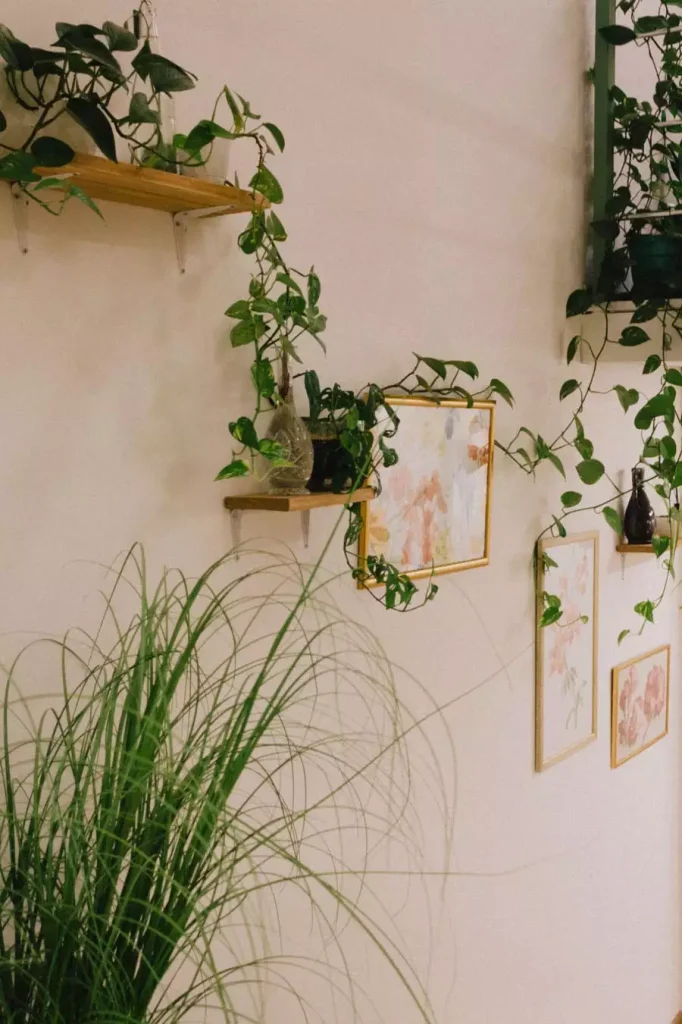
Trailing greenery connects several elements that would otherwise feel separate. The vines move from the upper shelf down the wall and toward the smaller shelves and floral prints nearby.
Because the shelves sit at different heights, the plant becomes the line that visually joins them. If you already have staggered shelves, allowing one trailing plant to bridge the gaps can make the whole arrangement feel more connected without adding more frames or objects.
Single Stems Taped Straight to a White Wall
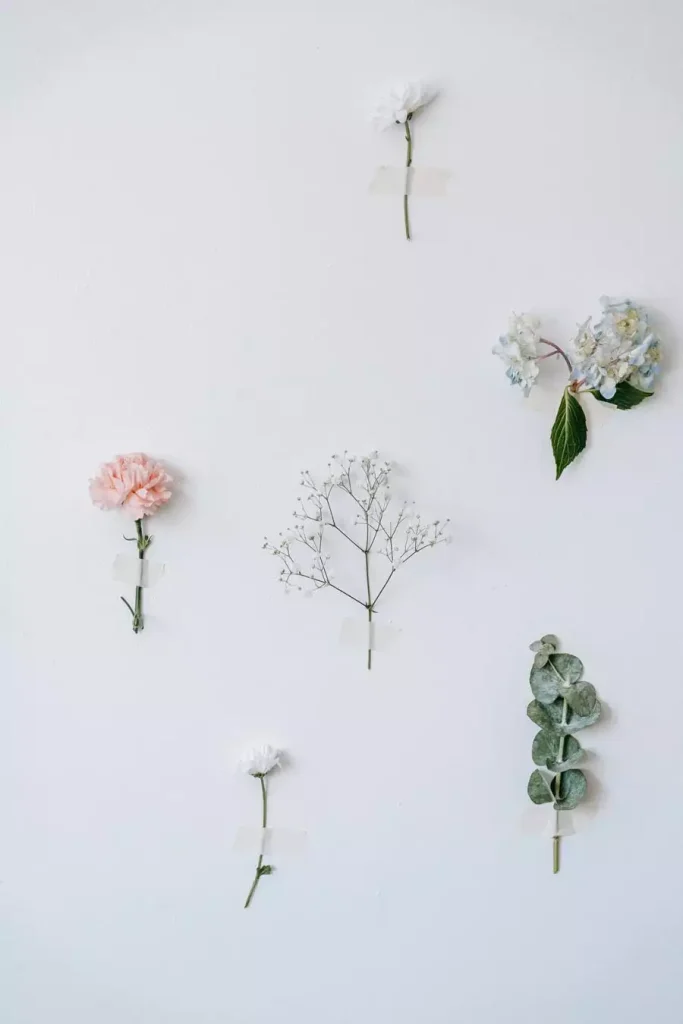
Six individual stems are spaced widely across this white wall instead of being gathered into one bouquet. Each one gets its own patch of empty space, making the arrangement feel closer to a loose botanical display.
The simple attachment method keeps attention on the flowers rather than on holders or frames. For something longer-lasting, dried stems make more sense than fresh flowers. If you are attaching them directly to a painted wall, a removable low-tack tape is the safer choice.
A Simple Macrame Piece on a Wooden Dowel
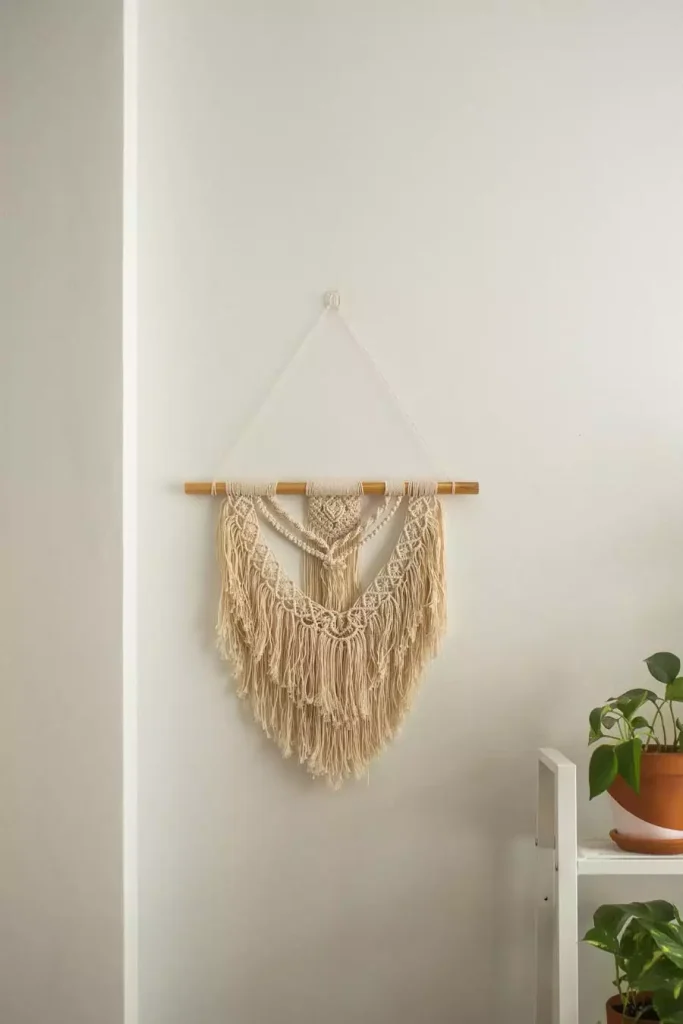
A wooden dowel supports this cream macrame hanging, with a central diamond, rows of knots, and long fringe forming most of the detail.
The surrounding wall is intentionally quiet. A shelf with potted plants sits off to the side rather than directly underneath, so the hanging still has its own space.
This is a good example of why a textured wall piece does not always need extra decor around it. On a plain wall, the knots and fringe are already enough to create interest.
Fringed Macrame Mirror Above a Potted Palm
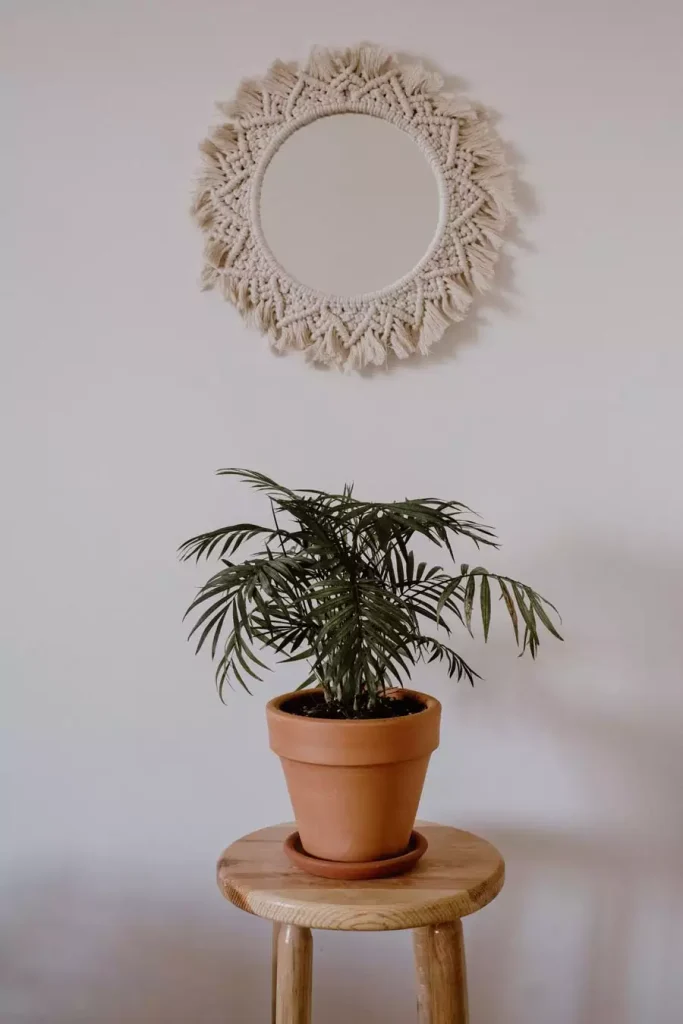
The mirror, plant, and wooden stool all sit along the same vertical line. That simple alignment is what makes the small arrangement feel intentional.
Pale macrame fringe spreads outward around the round mirror, while the dark green palm creates a stronger shape directly below it. If you are decorating a narrow wall, stacking a few related elements vertically can work better than spreading several small objects sideways.
A Black Round Mirror on a Mint Wall With Tiny Wildflowers
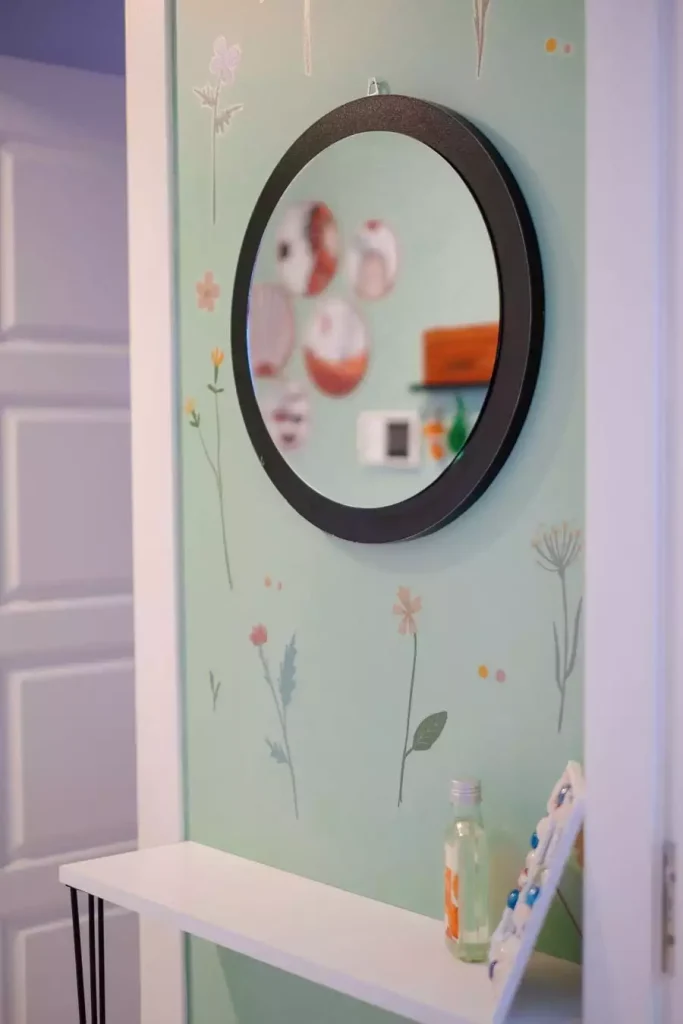
The dark round mirror creates a strong focal point against the pale mint wall, while the small wildflower illustrations stay light and delicate around it.
That contrast is what keeps the tiny floral details from disappearing completely. The mirror provides one bold shape, and the scattered stems soften the empty areas around it.
If you want a similar look without hand-painting the flowers, small removable wall decals could create the same scattered effect while keeping the mirror as the main feature.
Start With the Part You Want to Change
You do not need to recreate an entire room to borrow one of these ideas. A blank corner might only need a hanging plant, a narrow wall could suit a vertical piece, and a larger wall may be better for paint or a loose gallery.
Start with the space that feels unfinished, then choose the idea that fits its size and shape. Adjust the colors, number of pieces, and materials to suit what is already in your room rather than trying to copy every detail exactly.