
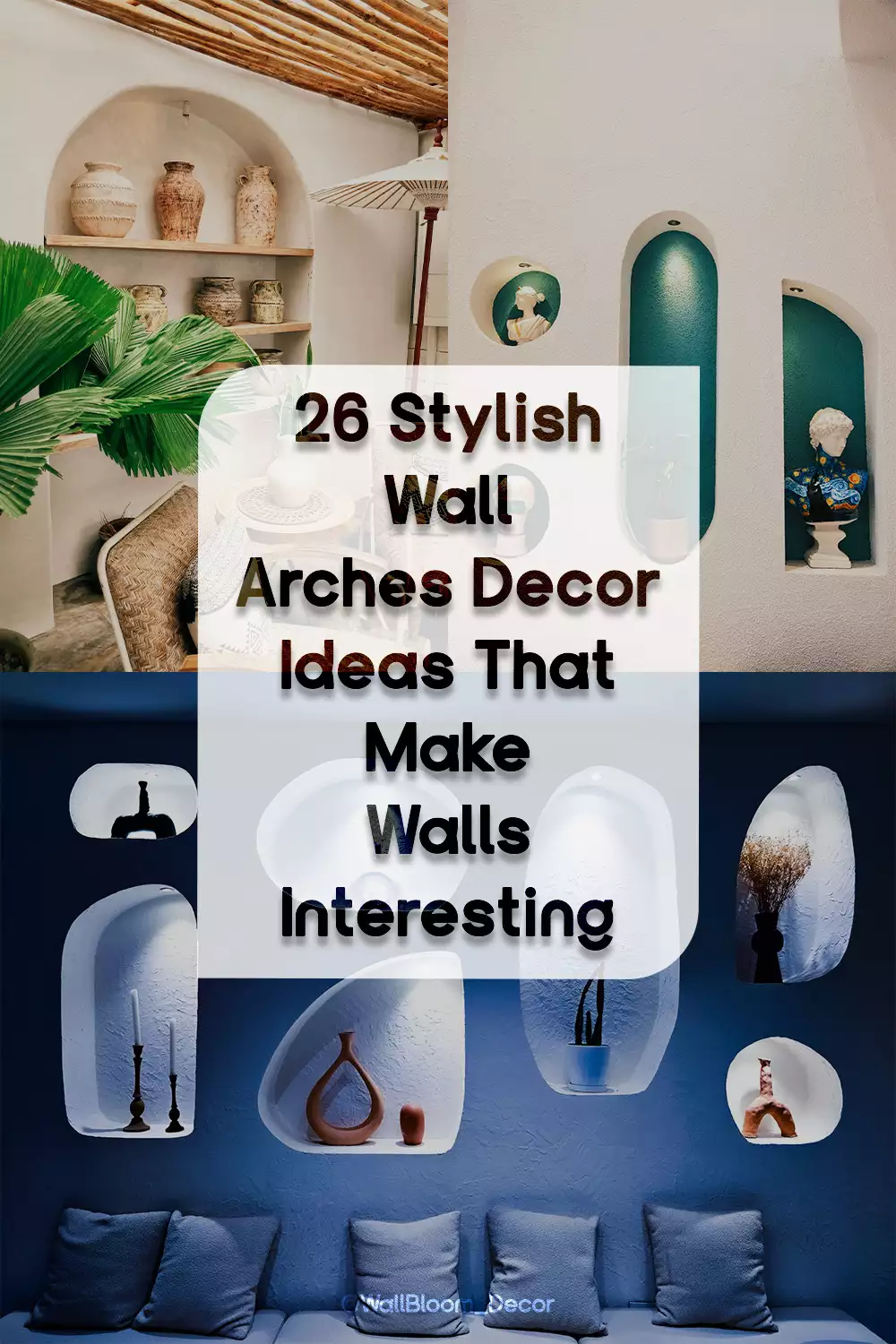
Arched niches have become one of those details that quietly define a room without taking it over. Once you start noticing them, they show up everywhere—carved into plaster, framed in brick, lined with light, holding nothing more than a single vase. This collection brings together 26 wall arch decor ideas, looking closely at how each design is built, lit, and styled.
Some of these are full architectural features spanning an entire wall. Others are a single quiet arch with one object inside it. Together, they give a good sense of how much range this one shape can offer, whether you’re working with plaster, brick, paint, or a built-in shelf unit.
A Deep Blue Wall Broken Up By Sculpted Niches
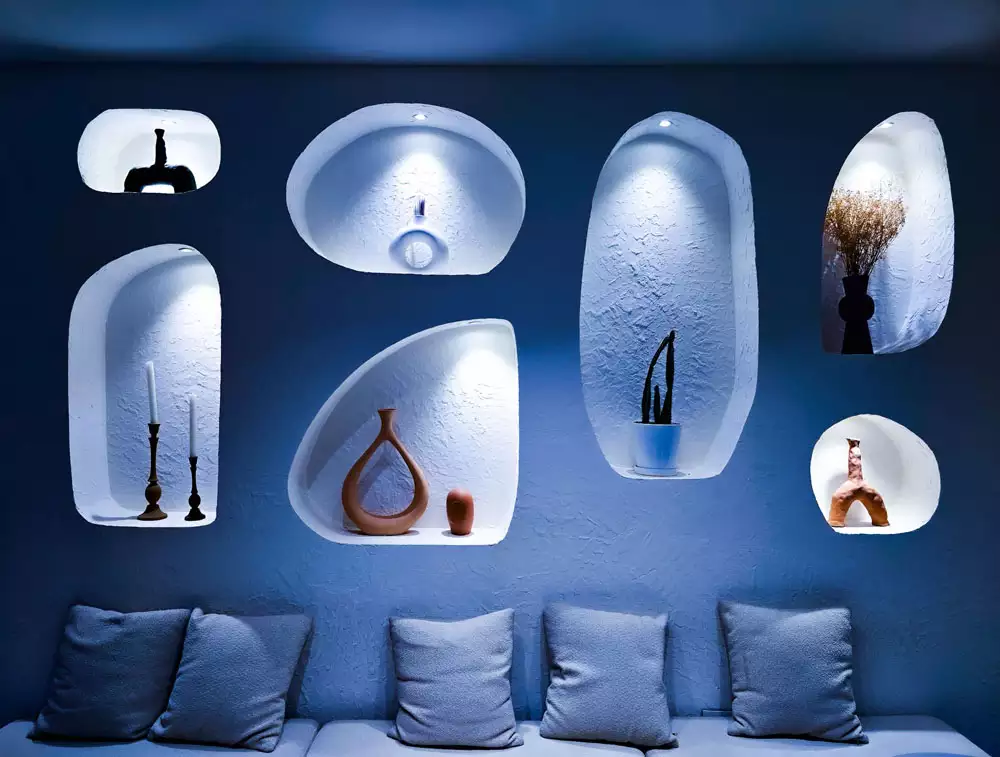
This wall takes a strong navy paint and lets a series of organically shaped white niches interrupt it—some rounded like pebbles, others closer to a classic arch. Nothing about the placement is perfectly symmetrical, which is part of what makes it interesting to look at.
Inside, the objects are kept small and spaced out: a pair of candlesticks, a teardrop vase, a single potted aloe, and a dark ceramic bottle tucked into one of the smaller openings. The boucle cushions lining the bench below pick up the same soft grey-white tone as the niches.
It’s a good reminder that a wall arch doesn’t need a symmetrical grid to feel intentional. Uneven spacing, when the shapes themselves are confident, still reads as designed rather than random.
A Corner Dining Nook Framed By Arched Cutouts
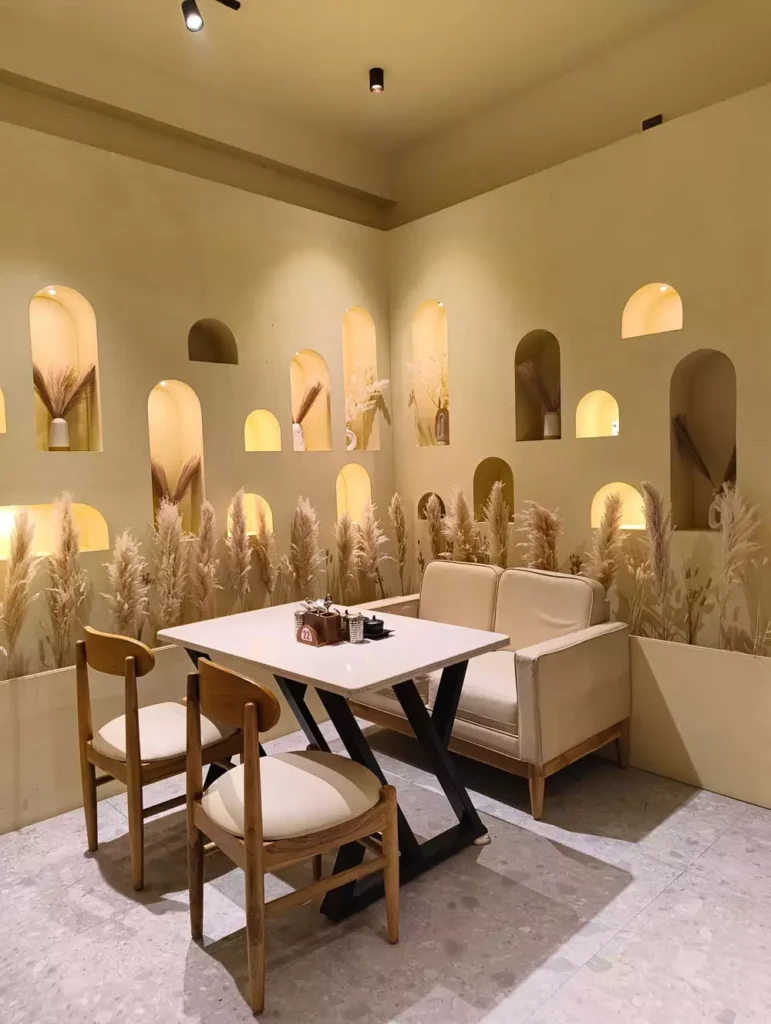
Here, the arches wrap an entire corner, stacked at different heights along two walls that meet at a right angle. The warm mustard-yellow paint and soft ceiling spotlighting give the whole nook a glow that makes the space feel larger than the small dining table sitting inside it.
Dried pampas grass fills several of the niches, along with a scattering of small vases. The plants are left loose rather than trimmed into a tidy shape, which suits the slightly wild, sandy palette of the room.
Below, a marble-topped table and simple wood chairs keep the seating area from competing with the wall. The arches do the visual work; the furniture stays quiet.
A Moody Cafe Corner With a Hanging Basket Arch
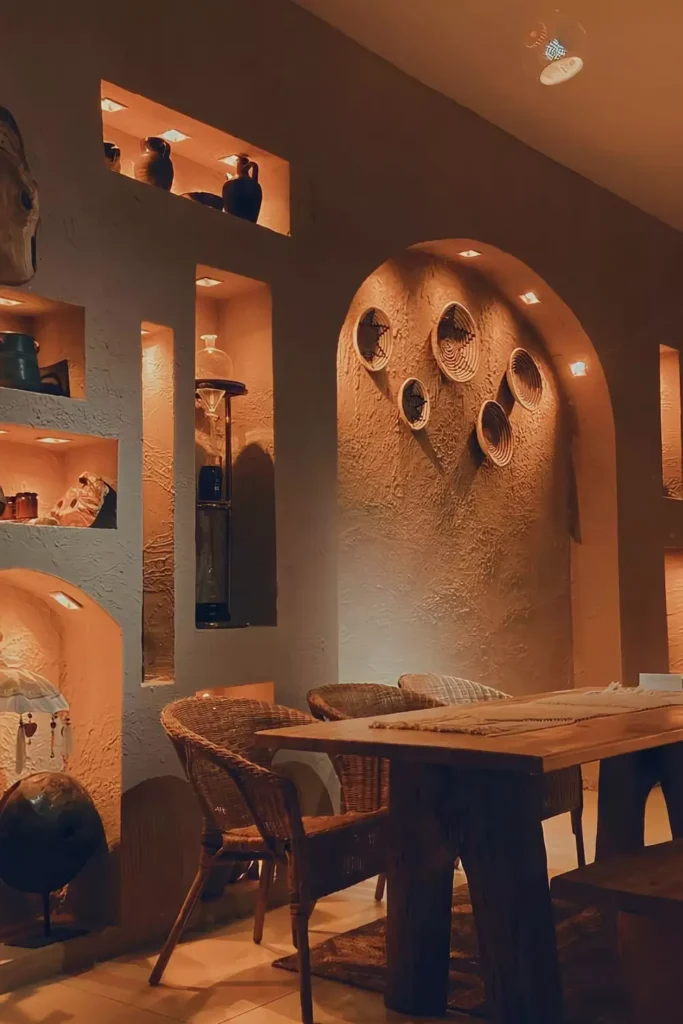
This one leans dark and atmospheric. A single tall arch is cut into a heavily textured plaster wall, and instead of shelves, it holds a cluster of round woven baskets mounted directly onto the curved surface—an unusual way to fill an arch without adding a single vase.
To the side, a run of smaller box niches holds pottery, a carved wooden mask, and glass vessels, each lit from within so the shapes stand out against the dim room. A heavy wooden table and rattan chairs sit close to the wall, keeping the seating intimate.
The lighting is doing most of the heavy lifting for the atmosphere here. Without the warm glow inside each niche, the wall would read as plain stone rather than a display.
A Single Arch Holding One Sculptural Plant
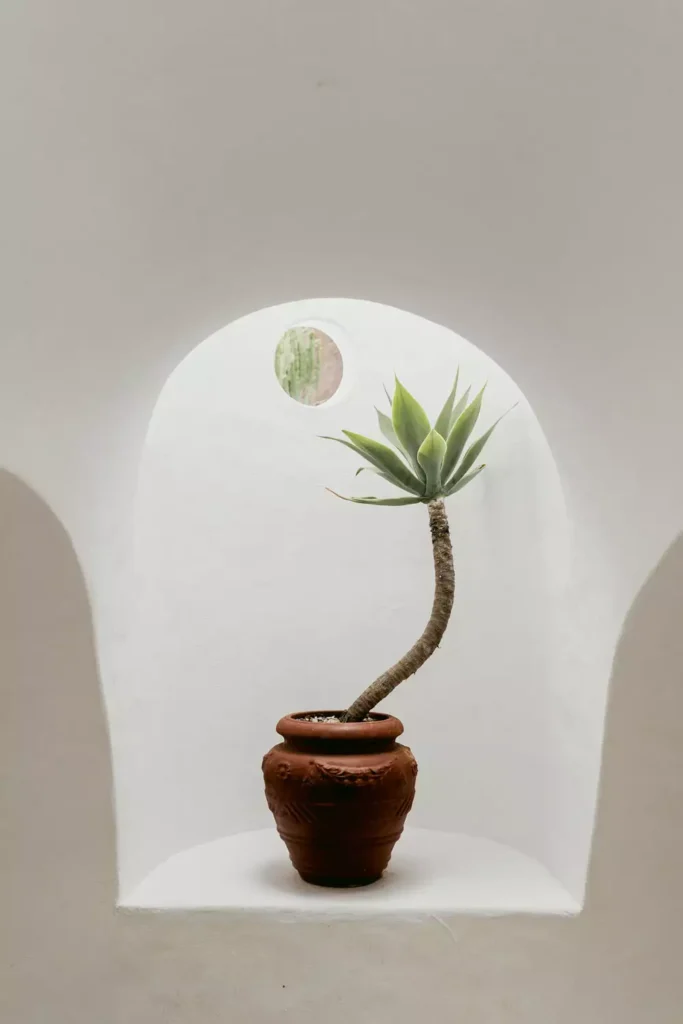
Sometimes the simplest version works best. This niche is tall and plain white, with a small round cutout above it that lets a sliver of light or view through. Inside sits one terracotta pot with a curving, sculptural agave-type plant, its stem bending in a long arc toward the opening.
There’s no other decor competing for attention. The plant’s shape essentially becomes the art, and the arch acts like a frame around it rather than storage for a collection.
It’s a useful approach for anyone who wants the impact of an arch without needing to gather several objects to fill it.
A Long Backlit Arch in a Dim Hallway
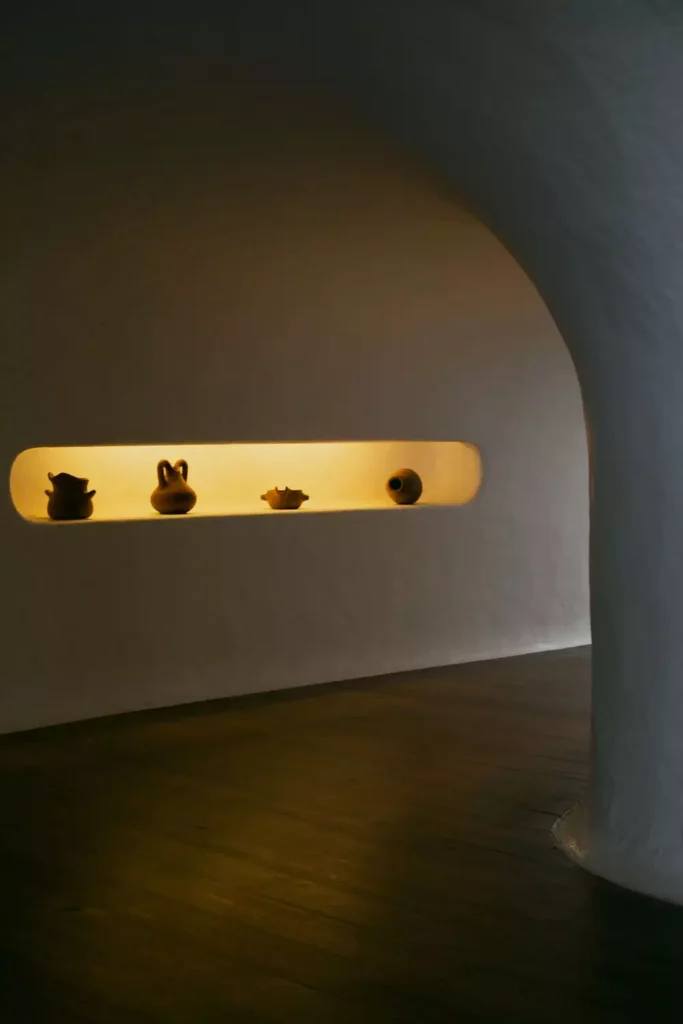
This narrow, elongated arch stretches horizontally rather than the usual vertical shape, cut low into a dark plaster wall. Warm light glows from behind it, throwing the four small clay vessels inside into silhouette.
The rest of the hallway stays almost entirely in shadow—dark wood flooring, a rounded plaster column to the side. That contrast is what makes the lit arch feel like the one focal point in an otherwise minimal space.
It’s a good example of how a wall arch can function almost like a piece of wall art when the lighting is treated as part of the design rather than an afterthought.
A Terracotta Wall Packed With Backlit Openings
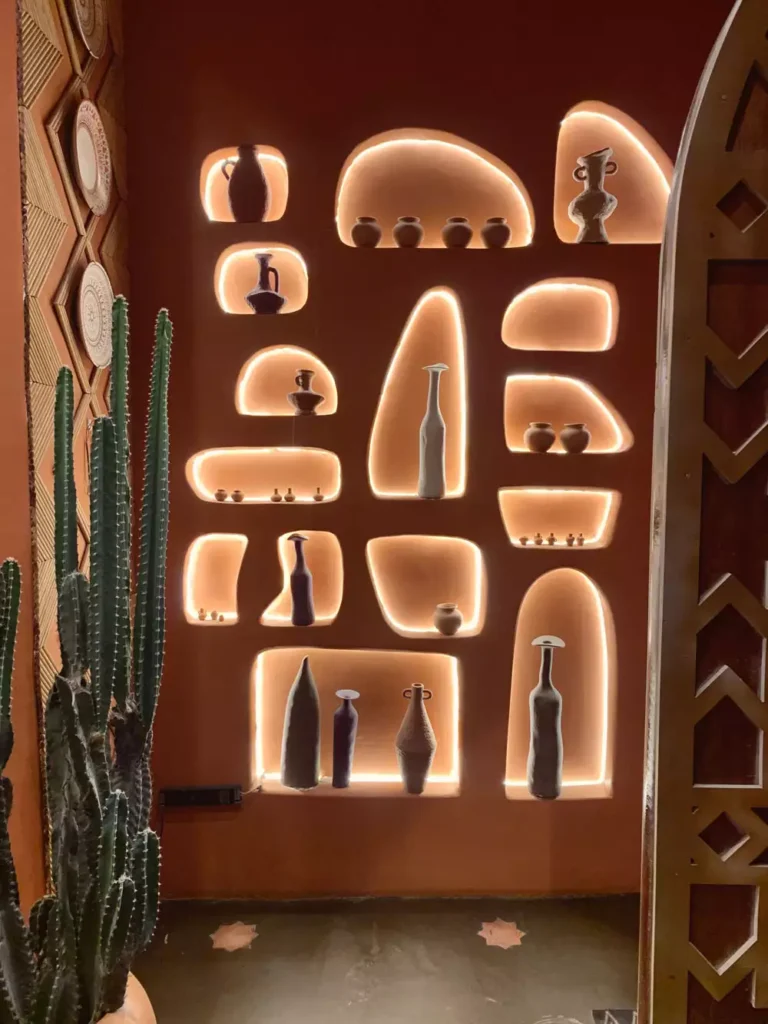
This is one of the busier arrangements in the group—a deep rust-orange wall covered in niches of every shape: rounded arches, ovals, and soft rectangles, all outlined with a thin strip of warm LED light. Each one holds a different ceramic vase or jug, so no two openings look quite the same.
A large cactus sits in the foreground, and an ornate wood cutout screen stands just beside the wall, adding a second layer of pattern. Star-shaped tiles are set into the floor below.
With this many niches on one wall, the trick seems to be variety without matching—different vase heights, different glazes, different silhouettes, but a consistent warm light tying it all together.
A Playful Arch On A Blue And White Wall
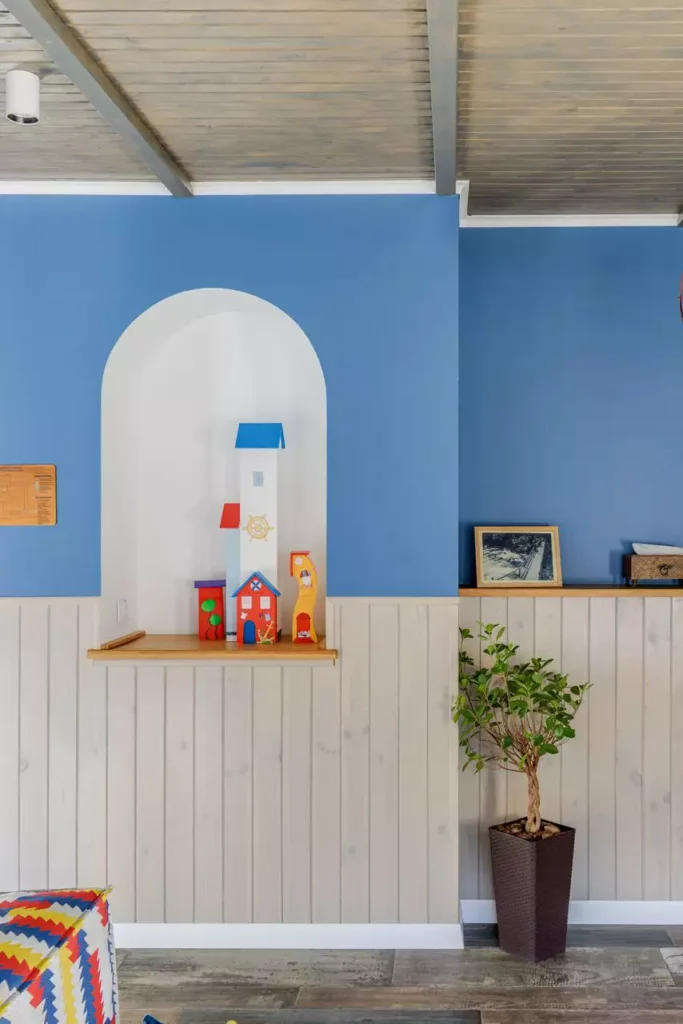
This niche sits in a kids’ or family space, judging by the small wooden toy houses lined up on its narrow shelf. The upper wall is painted a clean blue, with white beadboard paneling below, and the single white arch breaks up that color block right where the two meet.
A potted citrus tree stands just outside the niche, and a corrugated metal ceiling overhead gives the room a slightly rustic, open feel.
It’s a nice example of how an arch doesn’t have to hold “decor” in the traditional sense—toys, books, or a child’s collection work just as well inside the same shape.
A Brick Arch Holding A Single Terracotta Jug
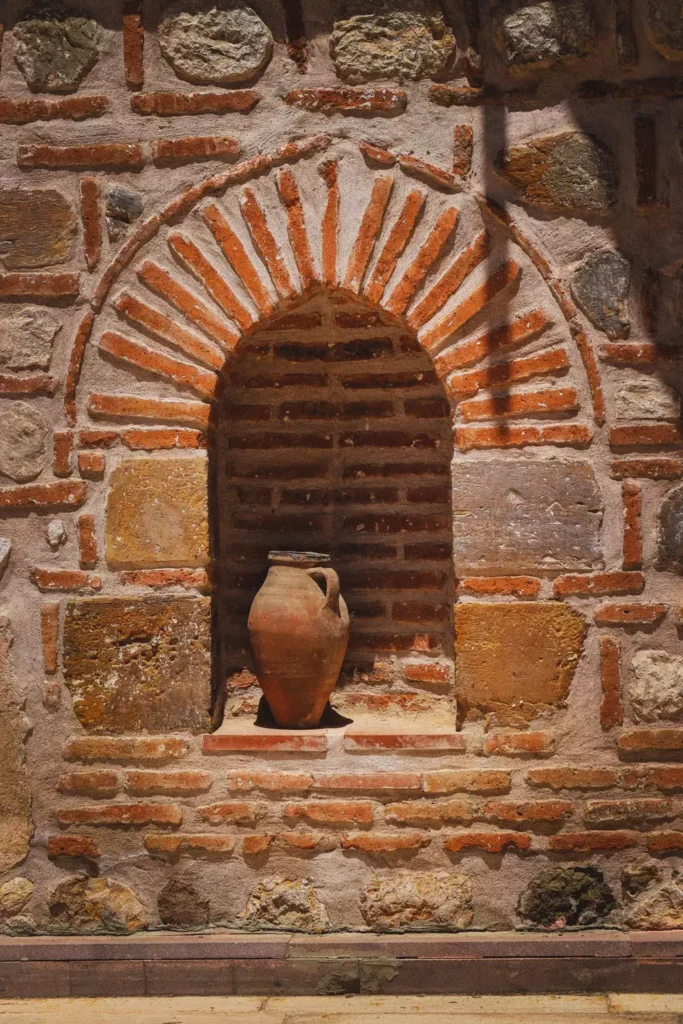
This is one of the more architectural entries here—an old stone and brick facade with a fan-brick arch built directly into the wall, the bricks radiating outward from the center in a classic voussoir pattern.
Inside sits one rustic terracotta jug with a simple handle, nothing else. Strong sunlight cuts across the brickwork, throwing deep shadows that make the texture of the stone and mortar even more visible.
There’s an argument here for restraint: this arch would lose some of its character if it were filled with more than one object.
A White Studio Arch Styled With Pampas Grass
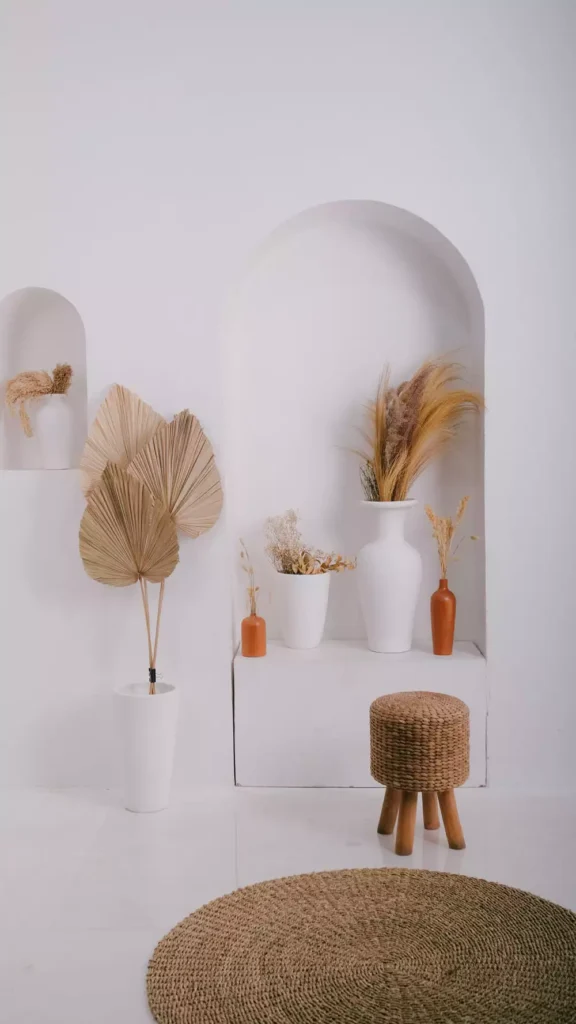
Set against an entirely white backdrop, this tall arched niche sits on a raised plinth and holds a large white vase filled with pampas grass, flanked by a couple of smaller terracotta bottles. A second, smaller arch is just visible at the edge of the frame.
Below, a woven wood-legged stool and a round jute rug bring in the only texture that isn’t plaster or ceramic.
The whole setup reads more like a styled studio shot than a lived-in room, which makes it a useful reference if you’re planning a single feature arch rather than a full wall.
A Curved Wall Mixing Arches and Square Niches
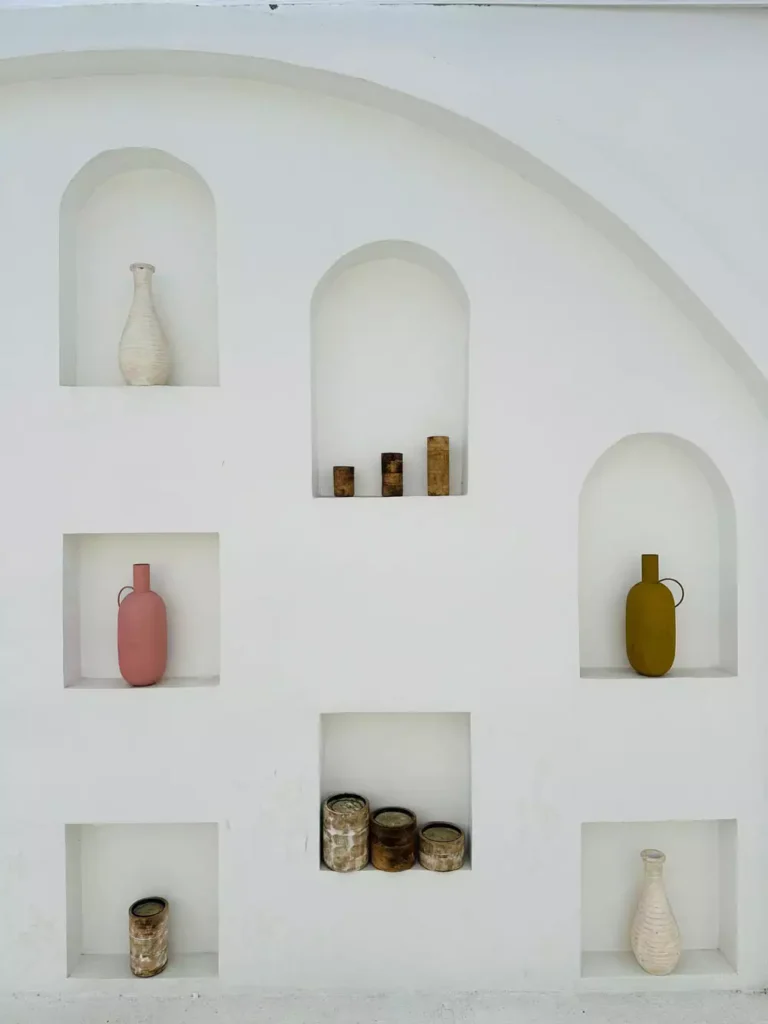
This wall takes a different approach to repetition—instead of matching every niche, it alternates rounded arches with plain square cutouts across a soft, slightly curved white surface. Each opening holds exactly one vase, in a different color: blush pink, mustard, cream, and deep brown.
Keeping each niche to a single object is what keeps the wall from feeling cluttered, even with this many openings across the surface.
It’s a good layout to study if you like the idea of a gallery-style wall but want it to stay calm rather than busy.
A Backlit Arch Shelving Unit Full of Pottery
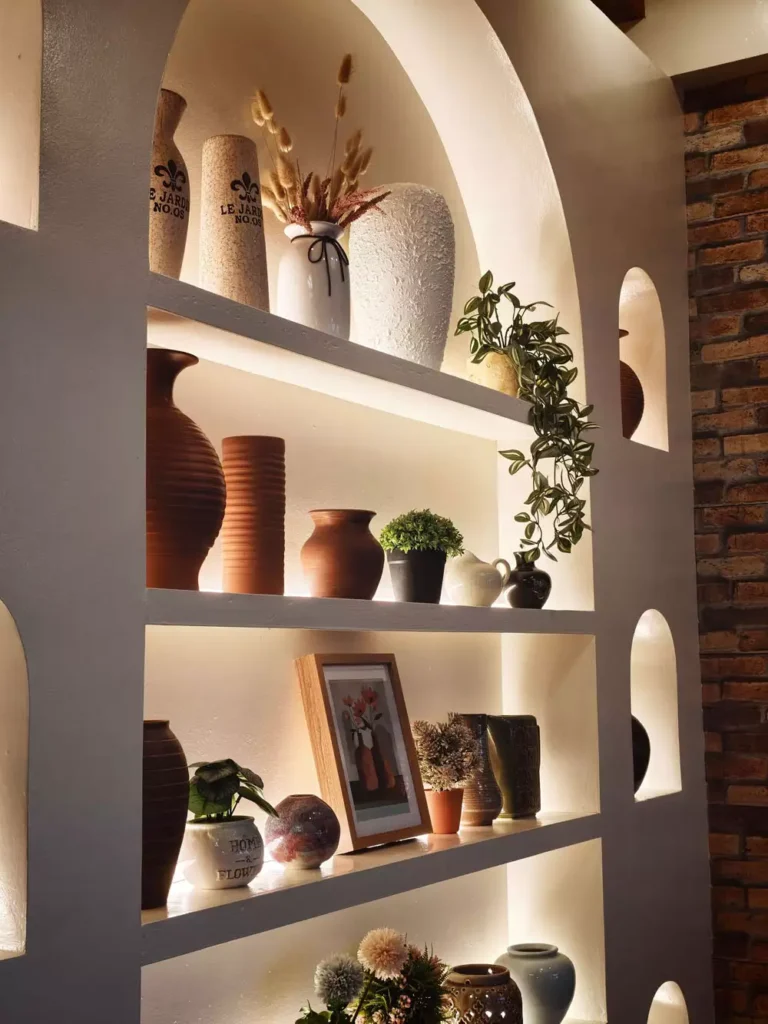
This is a fully built-in unit rather than a simple cutout—a large arch houses several stacked shelves, each lit from beneath so the pottery glows against the plaster. The top shelf holds a pair of cork vases printed with “Le Jardin,” a tall textured white vase, and dried grasses in a smaller jug.
Lower shelves mix terracotta jars, a framed botanical print, small potted plants, and a trailing pothos that spills down over the shelf edge and into the next section of the arch.
A brick wall is visible just beside the unit, which grounds the soft plaster curves in something more solid.
What stands out is the layering—nothing sits in a single tidy row, and the plant vines are left to hang naturally rather than being trained along the shelf.
Classical Busts Set Into Teal-Lined Niches

Here, the inside of each niche is painted a saturated teal, which creates strong contrast against the surrounding white wall. Two small circular openings hold classical-style busts, one wearing a painted design in a starry, swirling pattern. A tall oval arch beside them holds a young potted plant instead of a sculpture.
The shapes vary quite a bit—full circles, an elongated oval, and a rounded-top rectangle—but the consistent teal backing ties the group together even though no two openings are the same size.
This is a good option for anyone who wants their wall arches to feel more like a small gallery than a storage shelf.
A Plaster Wall Densely Lined With Amphora Jugs
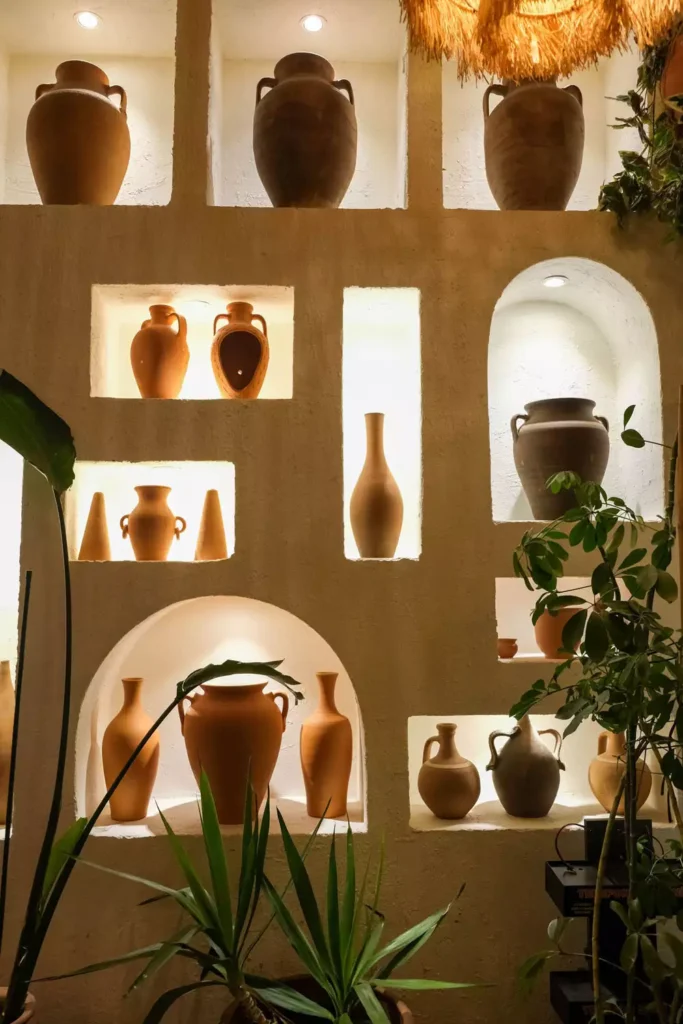
This wall commits fully to one material story: terracotta. Arched and rectangular niches of different sizes are packed with amphora-style jugs and vases, ranging from small handled pitchers to one oversized urn sitting in its own arched opening.
A straw pendant lamp hangs just above the display, and greenery spills in from the edges of the frame, softening what could otherwise feel like a very dense wall of pottery.
With this much repetition of the same material, the variation in height and shape is what keeps each niche readable on its own rather than blurring together.
A Tall Arch Framing A Single Potted Tree
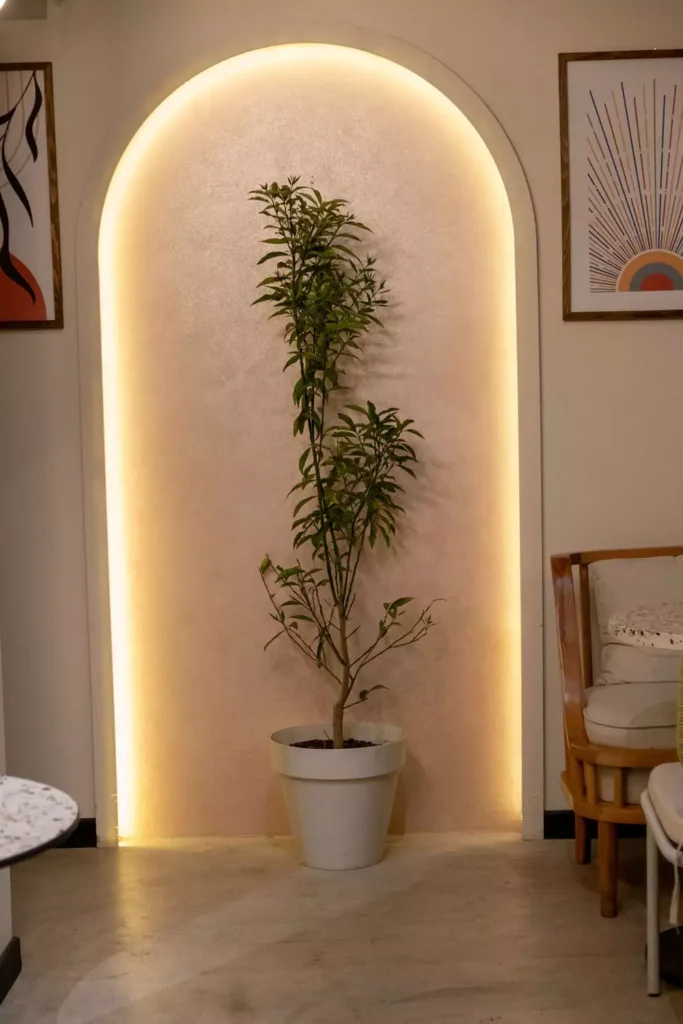
This niche is kept deliberately simple—one backlit arch, one leafy potted tree standing centered inside it. Framed artwork hangs on the wall to either side, giving the arch a sense of symmetry even though it’s the only three-dimensional object in the group.
The warm strip lighting outlines the curve of the arch clearly, which draws the eye upward along the plant’s height rather than across the wall.
It’s proof that one well-placed plant can carry an entire niche without any additional styling.
A Cluster Of Tiny Arches Above A Marble Table
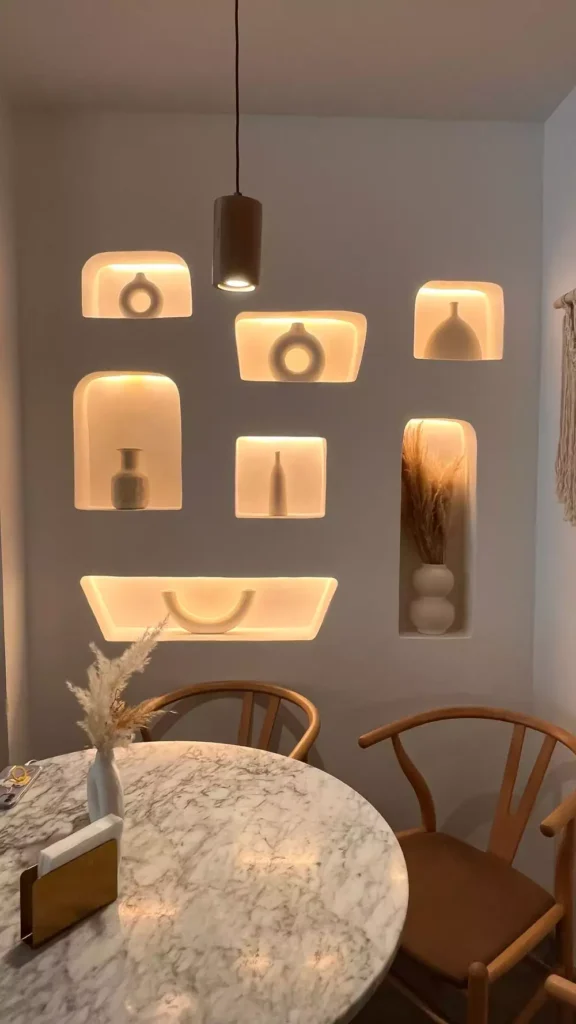
This grouping is made up of several small niches, some arched and some square, each holding a single minimalist vase silhouette. They’re mounted higher on the wall, above a round marble-topped table and a set of bentwood chairs, with a pendant light hanging down between the table and the niches.
Because the vases are so pared back—mostly plain curved or angular forms in a neutral tone—the niches themselves become the main visual interest rather than the objects inside them.
It’s a compact way to bring the arch idea into a small dining corner without needing a full wall.
A Styled Shelf Mixing A Bust, A Teacup, And A Brass Beaker

This close-up view shows a set of white arched niches used almost like a curated shelf. One holds a small classical bust beneath a hanging pendant light. Another has a bundle of dried wheat in a glass vessel, a compact vintage camera, and a stack of books leaning against the side wall.
Lower down, two smaller arches each hold just one object—a teacup and saucer in one, a brass bee figurine in the other. Large glossy leaves from a houseplant frame the left edge of the photo.
The mix of objects here—camera, books, ceramics, a small brass creature—feels more like a personal collection than a matched decor set, which is part of what makes it interesting to look at slowly.
A Patio Arch Lined With Weathered Clay Pots
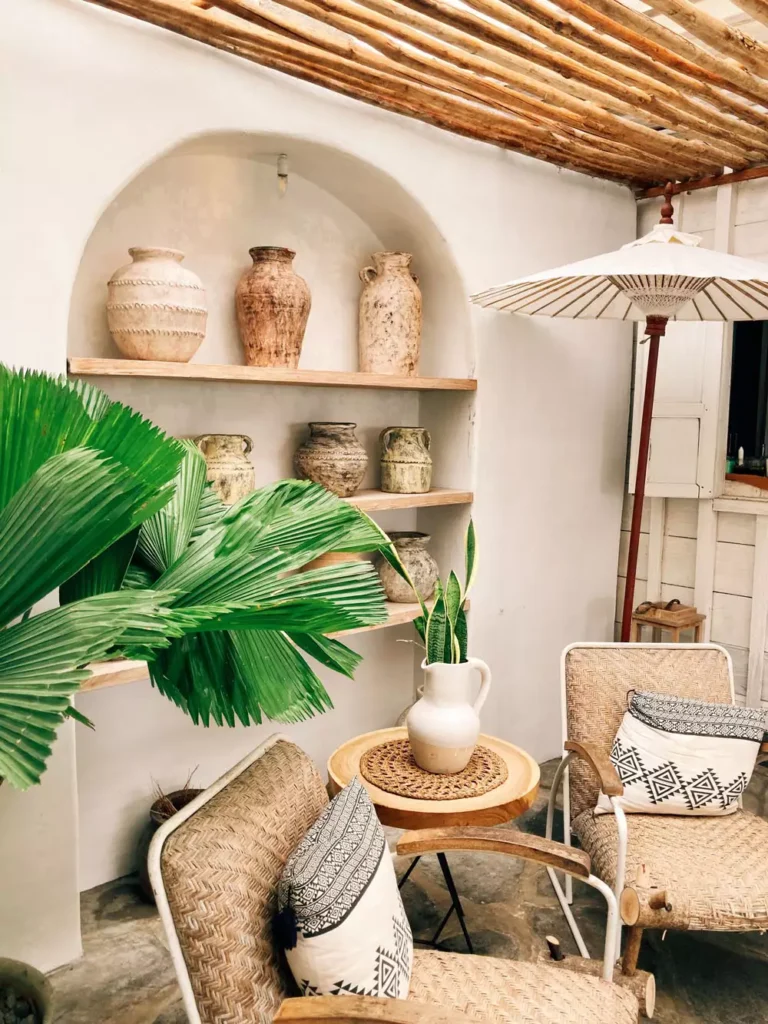
Outdoors, this whitewashed arch holds two simple wood shelves stacked with rustic, weathered clay pots and jugs in varying earthy tones. A large fan palm frond crosses in front of the niche, and rattan chairs with black-and-white patterned cushions sit just below.
A bamboo pole ceiling overhead and a paper umbrella to the side round out the relaxed, outdoor feel.
The weathering on the pots is left visible rather than cleaned up, which suits the patio setting far better than glossy ceramics would.
An Ornate Moroccan-Style Arch With Painted Plates
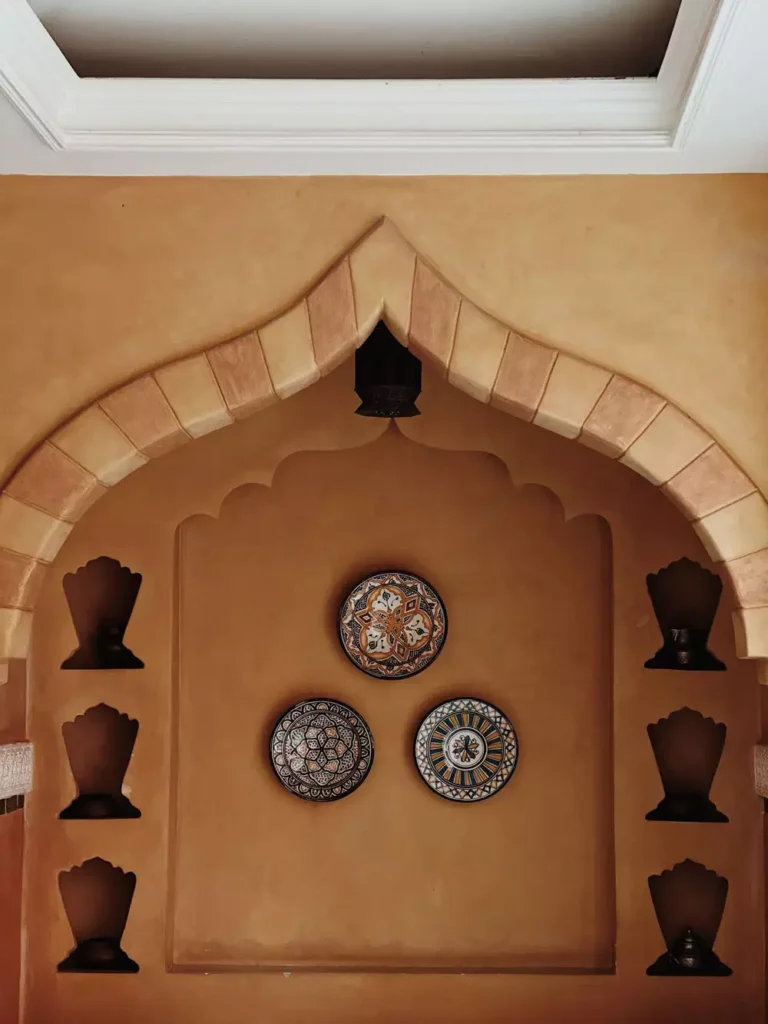
This niche takes a very different shape from the rest—a pointed, scalloped arch built into a mustard-orange wall, with small shell-shaped side niches holding dark lanterns on either side. Three hand-painted ceramic plates are mounted in the center, each with its own geometric pattern.
The carved detailing at the top of the arch and the tiered side niches give this one a much more ornamental, architectural feel compared to the plainer plaster arches elsewhere in this list.
If you want a wall arch that reads as a statement piece on its own, without needing vases or plants to fill it, this kind of carved detail does that work instead.
A Stepped Arch Shelf Paired With A Plain Niche

This wall combines two ideas side by side—a plain, empty-feeling arched niche with just a tall potted plant standing in front of it, and next to it, a stepped, staircase-shaped shelf unit lined with terracotta jugs in several sizes.
A snake plant sits partway up the steps, and greenery hangs down over one edge, softening the otherwise geometric shelving.
Pairing a busy, layered arch with a nearly empty one nearby is a simple way to give the eye a place to rest.
A Warm Arch Above a Kitchen Sink
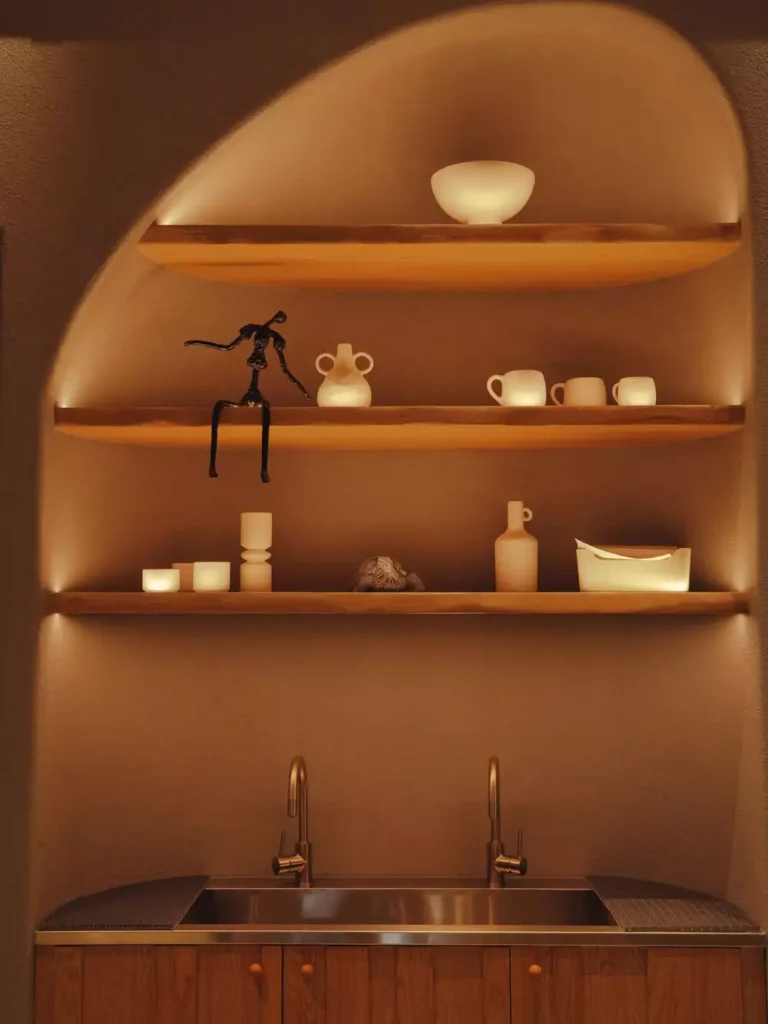
Here the arch sits above a practical spot—a kitchen sink with brass fixtures. Wood shelves span the width of the niche, holding a pale ceramic bowl, a trio of mugs, candle holders, and a small bronze wire figure perched casually on the shelf edge.
The warm, almost amber lighting makes the whole niche glow, which softens what could otherwise be a purely functional corner of the kitchen.
It’s a good example of a wall arch doing double duty—storage and display at the same time, right where it’s actually used.
A Sculptural Piece Tucked Into A Small Arch
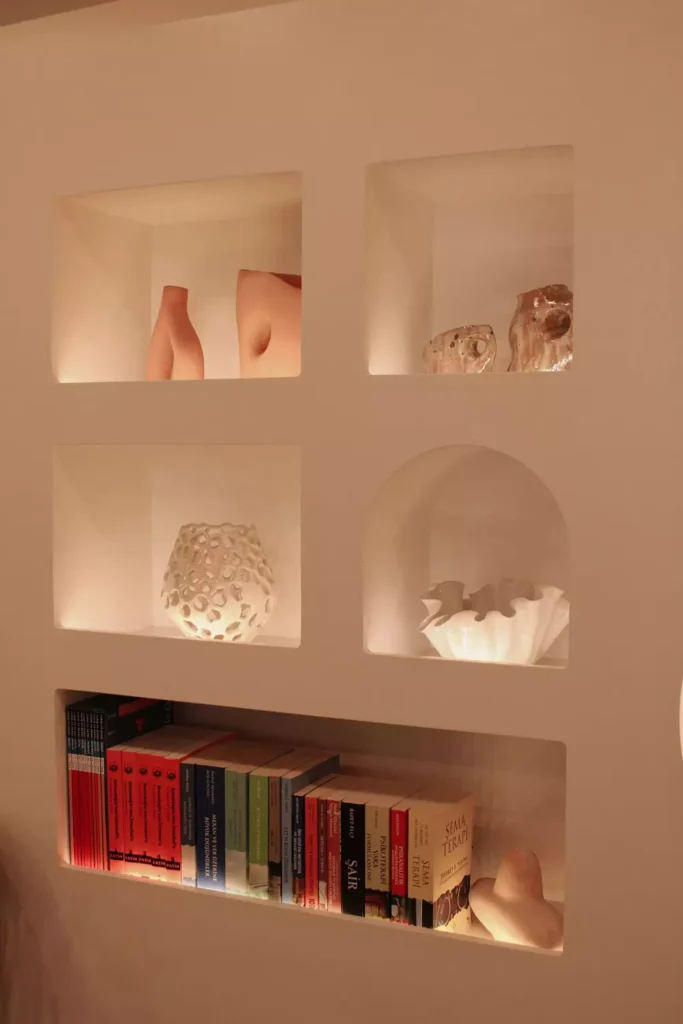
Most of the niches on this wall are plain squares, but one small arched cubby breaks the pattern, holding a curved, textured white sculpture that looks almost hand-formed. Nearby squares hold a coral-textured vase and a neat stack of books.
The angled view makes the depth of each cubby more obvious than a straight-on shot would, showing how far back the wall has been carved out.
Even a single arch among a run of squares is enough to add some variation to what would otherwise be a fairly uniform grid.
A Peach-Toned Arch Filled With Small Treasures

This niche is divided into a few smaller compartments within one larger arched opening, all painted in a warm peach tone that catches the light differently in each section. A ceramic vase holds a single dried branch, and a sculptural vessel with an unusual textured surface sits in the compartment beside it.
Lower down, a small stack of books leans next to a spiral nautilus shell ornament. Linen cushions on the sofa below pick up the same soft, warm palette as the wall.
The compartments keep each object visually separate, so even a fairly full arch doesn’t feel crowded.
Small Arches On A Heavily Textured Wall
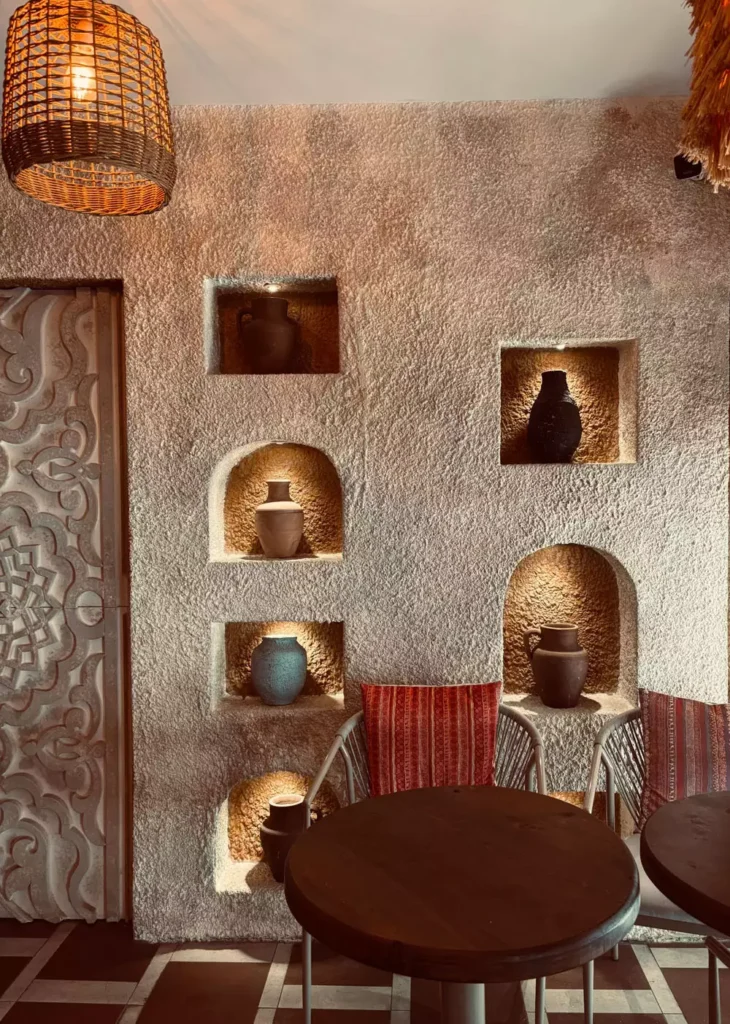
The plaster here is left rough and heavily textured, and the niches—a mix of arches and squares at staggered heights—each hold just one dark clay jug. A rattan pendant lamp hangs above, and striped cushioned chairs sit at a round table below.
Because every niche holds a single, similarly colored object, the texture of the wall itself becomes the main visual interest rather than the pottery.
It’s a useful reminder that the wall surface can carry as much of the design as anything placed inside it.
A Rugged Stone Niche With Brass Details
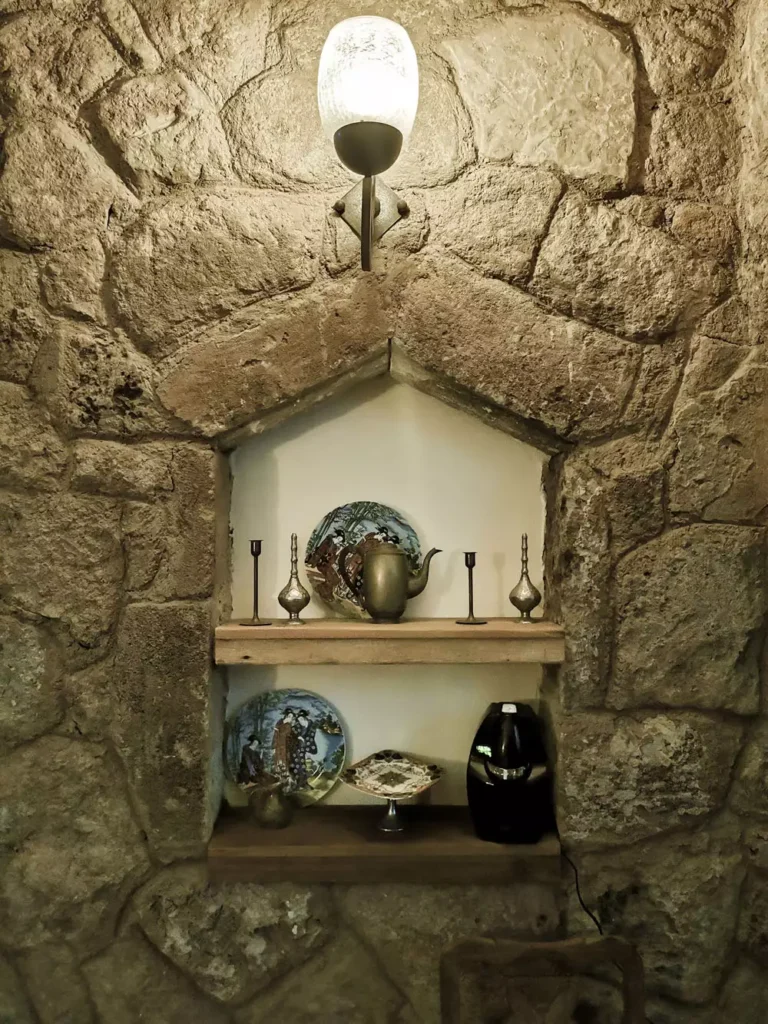
This arch is built into a rough, wooden, rural stone wall with a peaked, almost gabled top rather than a rounded curve. Two wood shelves inside hold a hand-painted plate, a brass teapot, a pair of candlesticks, and a small decorative dish. A wall sconce is mounted just above the niche, lighting the stonework from close range.
The stone itself is uneven and clearly old, which gives this niche a heavier, more historic feel than the smooth plaster arches elsewhere in the list.
The brass pieces catch the sconce light nicely, giving the shelf a bit of warmth against all that grey stone.
A Vintage Radio Set Beneath a Flowering Plant
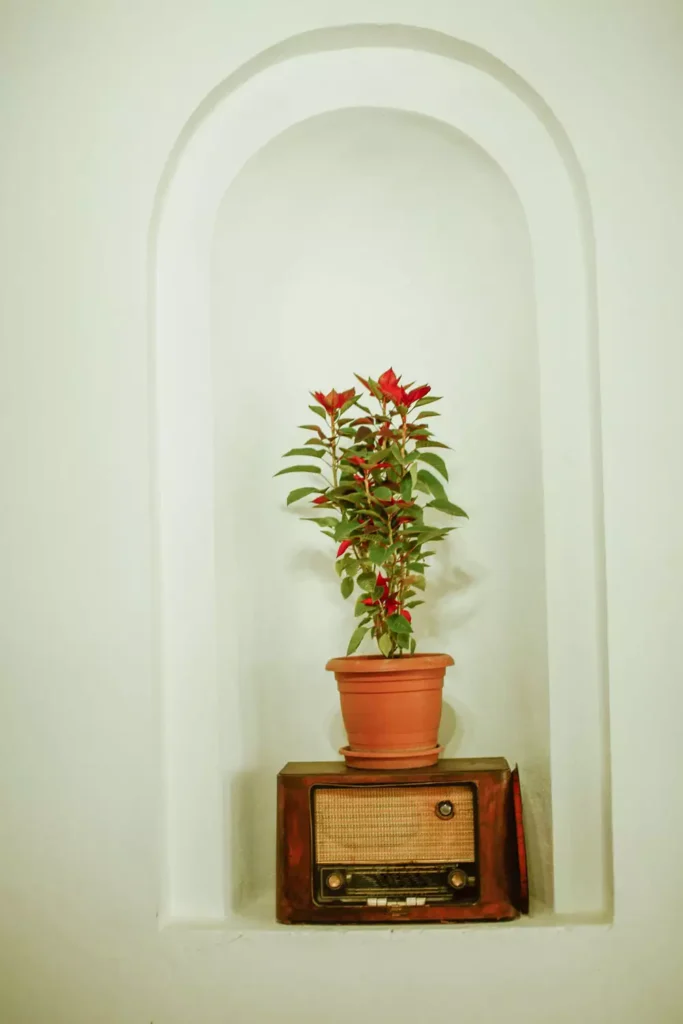
This arch keeps things simple and slightly unexpected—a tall, plain cream niche holding an old wood-cased radio, with a terracotta pot of red-flowering shrub sitting on top of it instead of a shelf.
There’s nothing else in the niche, which lets both the vintage radio and the plant’s red blooms stand out clearly against the pale wall.
Using a found object as a plant stand inside an arch is an easy way to add a bit of personality without buying anything new.
A Sculptural Staircase Wall Full Of Odd Shapes

The last one in this group might be the most architectural of all—a wide plaster wall built around a staircase, combining rounded arches, triangles, wavy-edged niches, and steps into one continuous sculptural surface. Small figurine sculptures sit tucked into a few of the deeper openings.
At the base, colorful line-art face cushions sit on a built-in bench, and palm leaves cross into the bottom of the frame.
Not every niche here holds something, and that’s part of the point—the shapes themselves are the decor, with the staircase functioning as much like a piece of wall art as it does as a way to get upstairs.
More Wall Space Than You Think
Looking through these many arches side by side, the differences in material, scale, and lighting matter more than any single formula. Some of these walls carry a whole collection of pottery; others hold nothing but one plant and a lot of empty plaster, and both versions work.
If any of these caught your eye, save the ones that fit your own wall best and start there—a single arch with one good object in it is often enough to notice the difference.