
Ceramic wall decor has a way of making a blank stretch of wall feel finished without needing a single frame. Plates, tiles, sculptural pieces, and even the odd flower or face planter can all do the job, and the best part is how differently each one reads depending on the wall color, the furniture nearby, and how tightly or loosely the pieces are grouped.
Below are 22 ceramic wall decor ideas, from staircases and kitchens to decorative market displays, each explored for what makes the arrangement work. Some are dense and busy, some use just two pieces on an otherwise empty wall, and a few aren’t plates at all. Take what fits your space and leave the rest.
Plates That Read Like a Little Landscape
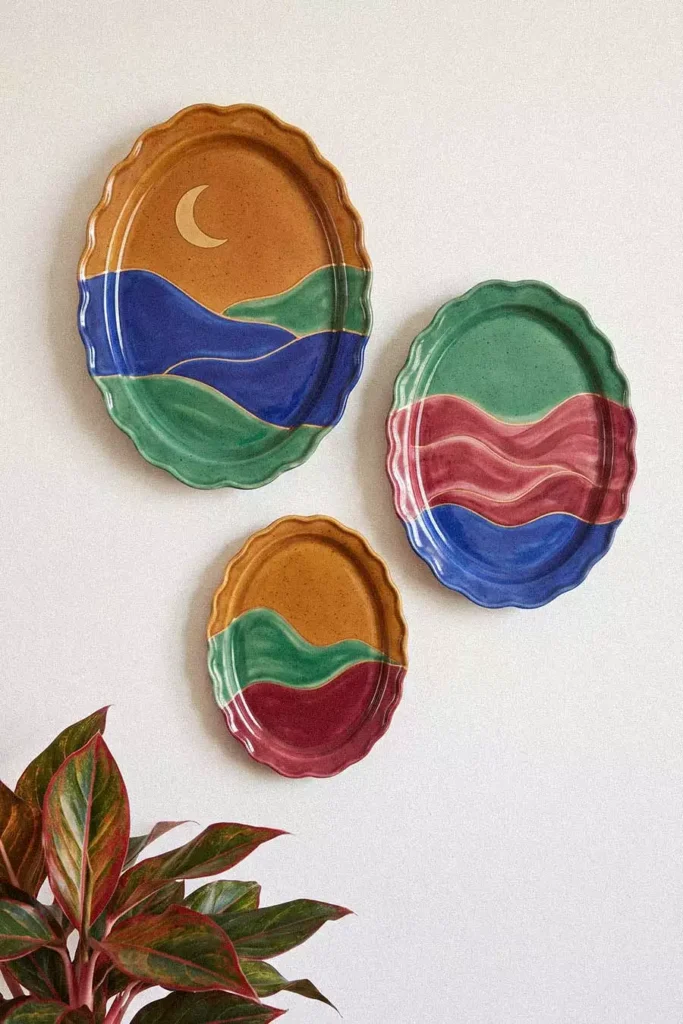
Three scalloped oval plates hang together here, each one painted like a tiny scene: a crescent moon over hills and water, a band of green and red waves, and a smaller plate repeating the same palette in miniature. The ruffled edges keep them from feeling too formal, almost like fabric caught mid-motion.
What stands out is the size variation. The largest plate sits at the top left, the smallest tucks in below and between the other two, and that staggered placement keeps the eye moving instead of settling flat.
A red and green houseplant sits just under the grouping, echoing the colors already painted onto the plates. If you’re arranging something similar, look at what’s already growing or sitting nearby before you commit to a palette.
A Diagonal Drift of Lotus Leaf Plates
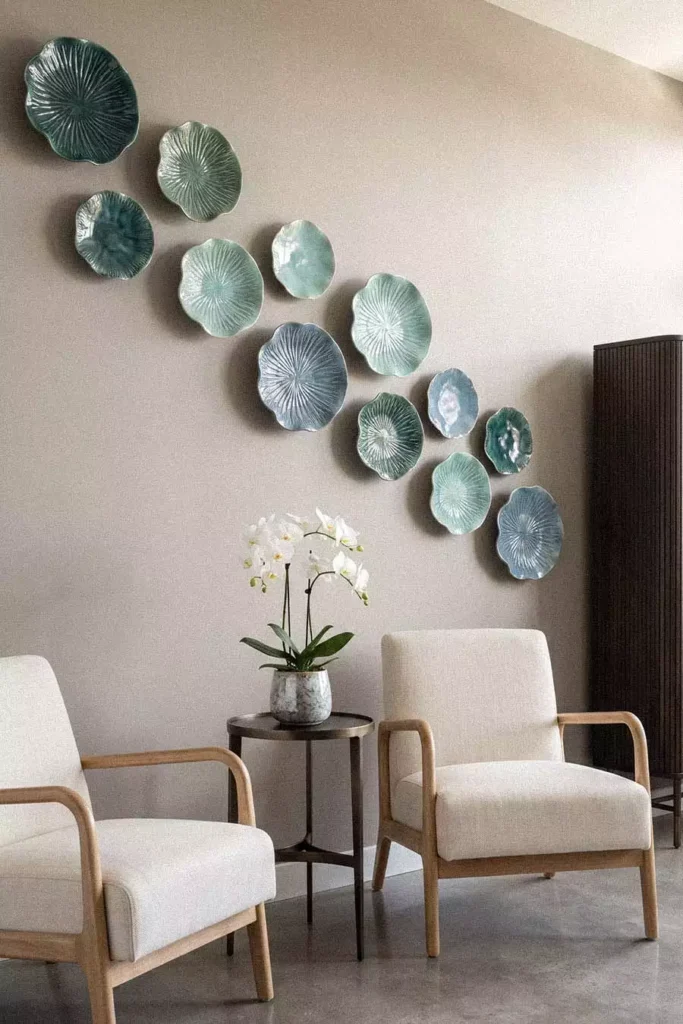
Instead of a tidy grid, this cluster of teal-glazed lotus leaf plates drifts diagonally across a taupe wall, thinning out as it goes. Some plates overlap in size, others sit isolated with breathing room, and the ridged, leaf-like texture catches light differently depending on the angle.
The color shifts subtly from deep teal at the top to a paler, almost blue-gray green lower down, which is easy to miss at a glance but gives the whole arrangement a sense of gradient rather than repetition.
Below, two cream wood armchairs and a round metal side table hold a single white orchid, and the quiet furniture lets the wall stay the main event. A cluster like this works best when the seating underneath doesn’t compete for attention.
A Dense, Playful Mix on a Pink Wall
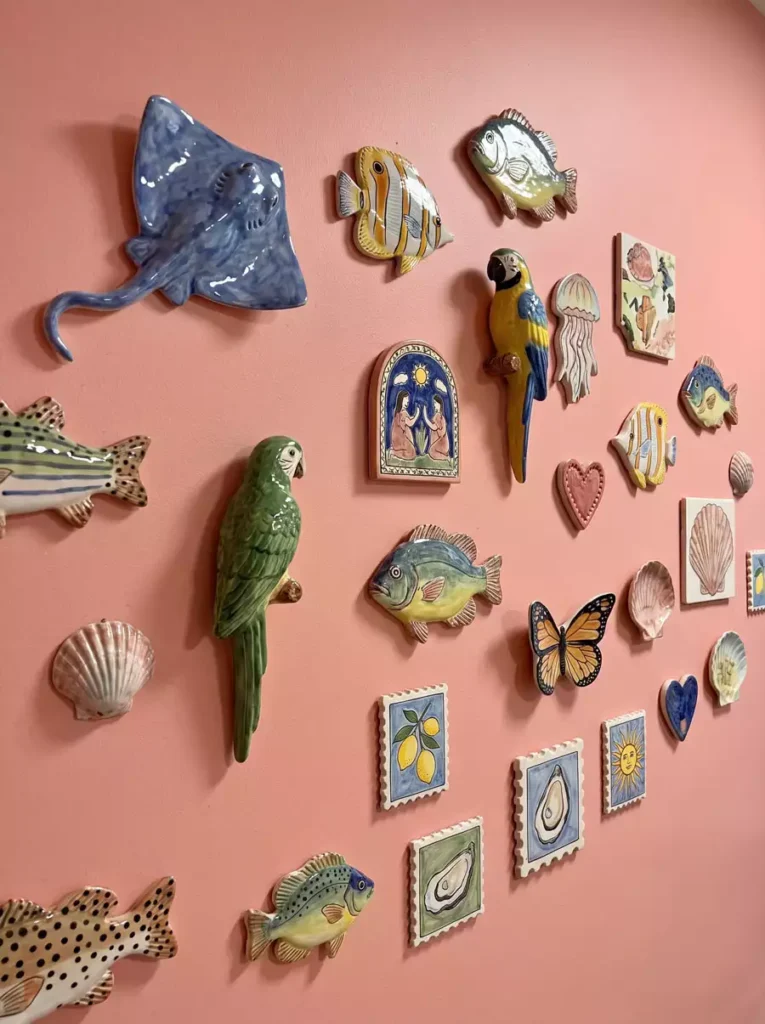
This is ceramic wall decor at its busiest: a blue stingray, a green parrot, striped fish, scallop shells, a butterfly, small square tiles with lemons and suns painted on them, and even a monarch-orange butterfly wedged between the rest. Nothing here is symmetrical, and it doesn’t need to be.
The pink wall does a lot of the work. It’s saturated enough to hold its own against dozens of small pieces, and it ties together colors that otherwise have nothing in common, from the stingray’s blue-gray glaze to the parrot’s yellow beak.
Look closely, and you’ll notice the pieces hang at slightly different heights rather than on one strict eye line, which helps keep a wall this packed from feeling stiff. If you’re collecting odd shapes over time, this kind of loose, organic fill is far more forgiving than trying to plan it out in advance.
Sculpted Faces That Double as Planters

Three ceramic face planters mount directly onto a plain white wall, each one holding succulents and long trailing stems that spill down over the sculpted features. The faces are simplified and calm, eyes closed or barely suggested, which keeps the focus on the plants rather than the vessel.
Two of the planters sit close together at a similar height while the third is set lower and to the side, giving the grouping a loose triangle shape instead of a straight line.
Trailing succulents like these need almost no upkeep, which makes this an easy way to bring in living texture without the wall decor turning into another watering chore.
Navy Lotus Plates Clustered Behind a Lamp
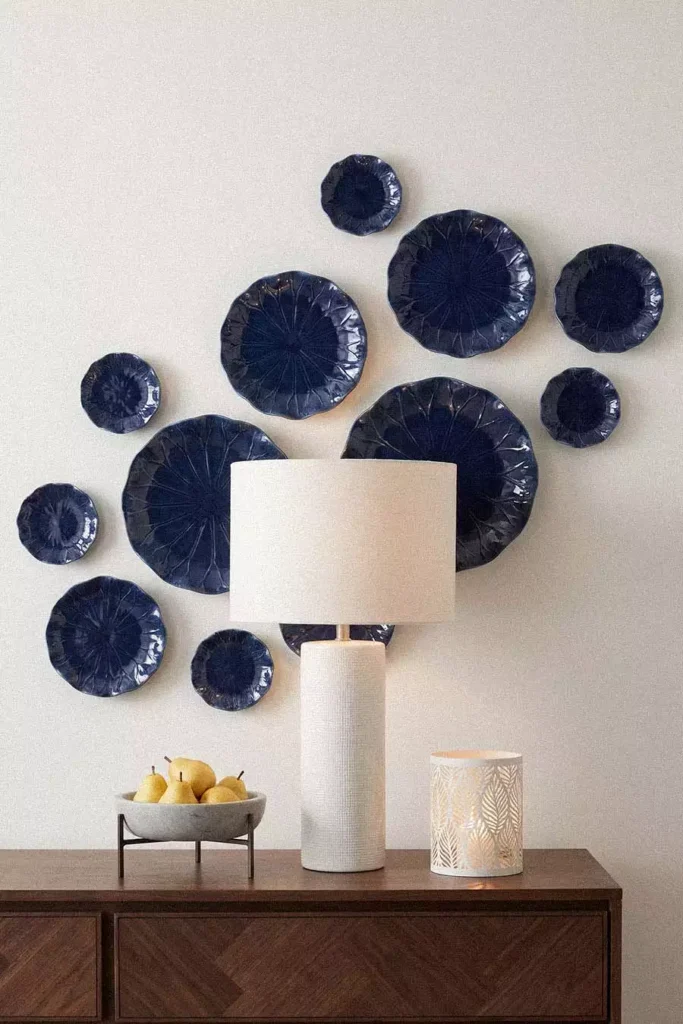
A dozen or so navy lotus leaf plates cluster tightly on a white wall, ranging from small saucer-sized pieces to larger dinner-plate ones. The glossy navy glaze catches enough light that individual ridges and petal lines are still visible even in a photo.
What’s interesting is how the arrangement is allowed to sit partly behind the lamp on the herringbone dresser below. Rather than leaving a gap for the lamp, the plates continue right through where the shade would otherwise block them, which makes the wall and the tabletop feel like one composition instead of two separate layers.
A bowl of pears and a pierced metal lantern round out the vignette. None of it matches in any strict sense, but the deep navy against warm wood keeps everything grounded.
A Lemon-Patterned Grid at a Market Stall

This one comes from a market stall rather than a living room, with hand-painted lemon plates and pierced chargers hung on a plain wire grid. The grid itself is worth noting: it’s a cheap, adjustable way to hang ceramics without drilling into a wall, and it’s just as usable at home as it is at a stall.
The plates vary in shape—round, oval, or square—but all share the same lemon-and-vine motif in yellow and green and touch on red or navy. Repetition of a single subject across different plate shapes is what keeps a mixed grouping like this from looking random.
Below, baskets of matching mugs echo the same pattern, a reminder that ceramic wall decor doesn’t have to stop at the wall. Picking one motif and carrying it into smaller tabletop pieces ties a whole corner together.
An Orchid and a Pansy, Just the Two of Them

Sometimes two pieces are enough. Here, a spotted cream orchid sits above a two-toned blue pansy, both mounted on a heavily textured white wall right beside a light switch.
The orchid’s deep red speckling and the pansy’s yellow center give this small pairing more color depth than the size suggests. Placing decor directly around a switch plate or outlet, instead of avoiding it, treats an awkward wall feature as part of the layout rather than something to work around.
Transferware Plates Framing an Antler Skull

This grouping leans traditional: brown and white transferware plates in oval and round shapes surround a mounted antler skull on white shiplap, with smaller antler mounts flanking either side. The plates form a loose arch shape that echoes the antlers themselves.
The palette stays almost entirely brown and cream, which lets the shiplap grooves and the antler’s natural texture stand out instead of competing with a lot of color. It’s a good example of ceramic wall decor working alongside a non-ceramic centerpiece rather than trying to be the whole show.
Below, a wood console holds twin lamps, more matching plates leaning against ginger jars, and a bowl of stone fruit. The repetition of the same plate pattern on the console ties the tabletop back to the wall above it.
A Sculptural Silver Piece With Real Depth

Not every idea here is flat. This square silver-framed piece is built from dozens of cup-shaped centers surrounded by radiating spikes, all in a matching pewter tone, mounted with enough depth that it casts a real shadow on the gray wall behind it.
The cups cluster in the middle like a cross-section of a flower, while the spikes fan outward toward the frame’s edges. It reads almost like a sea urchin or a burst of light frozen mid-explosion.
A piece this dimensional works well as a single statement rather than part of a gallery wall. It doesn’t need company to hold visual weight on its own.
Mandalas and Diamonds on a Mustard Wall
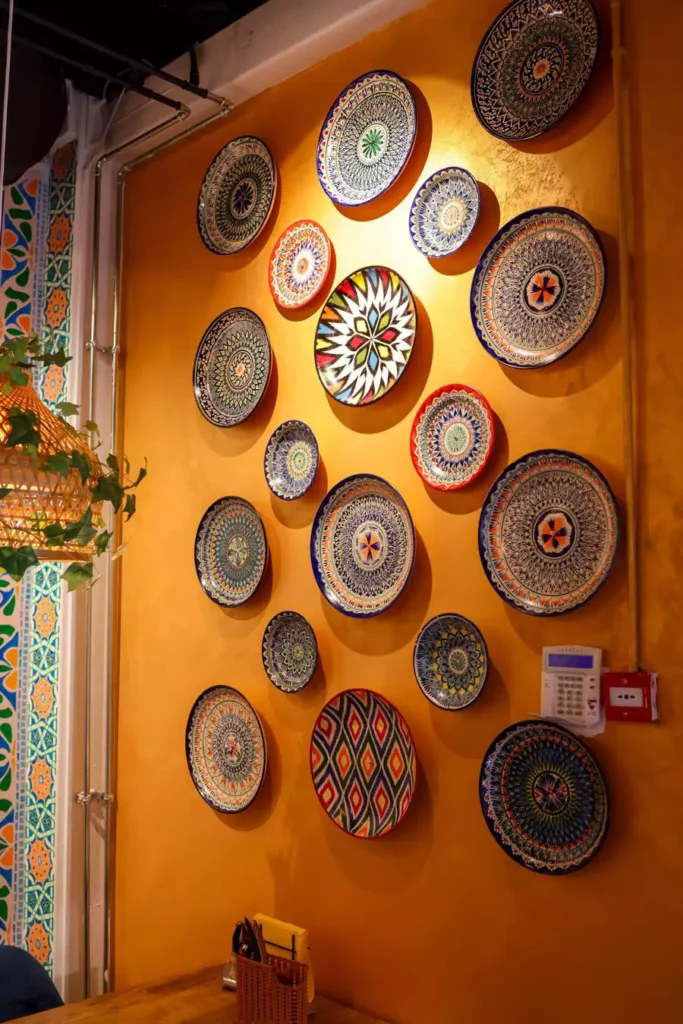
Nearly twenty round plates cover this mustard-colored restaurant wall, each painted with a different mandala, diamond, or geometric pattern in blues, reds, and golds. The warm lighting picks out the metallic and glazed highlights on the plates closest to the light fixture.
Sizes vary noticeably, from small saucer plates to large charger-sized pieces, and the spacing between them isn’t even. Some plates sit almost edge to edge, while others have a wide gap of bare wall around them, which keeps the eye from reading it as a uniform grid.
A mustard or ochre wall color is worth considering if your plate collection leans toward jewel tones. It warms up blues and greens that might otherwise feel cool or stark against plain white.
A Scalloped Pocket Holding an Air Plant

A single pink scalloped ceramic pocket, glazed in a dusty rose with a raw tan rim, hangs on a cream-paneled wall and holds one air plant. There’s no soil or water needed, just a plant that sits loose inside the bowl-shaped pocket.
The scalloped, flower-like edge gives this piece a handmade look even before you factor in the plant. It’s a low-commitment way to add ceramic wall decor to a small or awkward wall space, especially one where a full gallery wouldn’t fit.
Leaf Plates Climbing a Staircase Wall

Nearly twenty small leaf-shaped plates climb a tall cream stair wall in amber, rust, olive, and sage, arranged in a loose diagonal band that follows the line of the staircase itself. Each leaf has a raised center vein, so the shadows shift as you move past them going up or down the stairs.
The color story here moves from warm gold and orange at the top toward deeper olive and sage green lower down, which mirrors the kind of gradient you’d see in actual autumn leaves without spelling it out too literally.
A fiddle leaf fig sits at the base near the handrail, and the real plant’s green tones pick up the leaf plates’ cooler colors. Stair walls are often left bare because they’re awkward to hang on, but a scattered, diagonal layout like this one is far more forgiving of an uneven wall angle than a straight grid would be.
A Teapot Pouring Flowers Instead of Tea
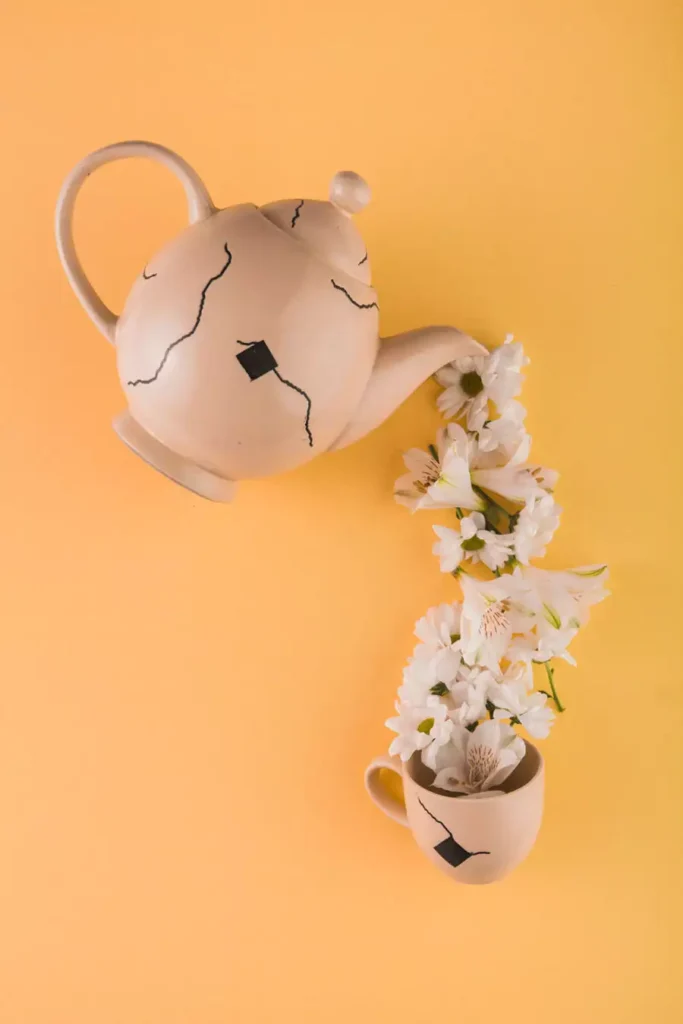
This is more of a styled still life than a wall installation: a cream ceramic teapot with hand-drawn black line details, arranged as though it’s pouring a stream of white flowers into a matching cup below, all shot against a solid yellow background.
The teapot and cup share the same crackled, sketched pattern, which makes them read as a set even when photographed flat on a table. It’s the kind of image that works well as inspiration for a small still-life vignette on a shelf or ledge rather than a full wall grouping.
If you have a teapot or pitcher you love but no longer use for its original purpose, letting it hold cut flowers instead is a simple way to keep it visible.
A Triangle of Willow-Pattern Plates

Eleven matching octagonal plates in an aqua and teal Chinoiserie pattern are arranged into a triangle shape on a peach-colored wall, wide at the top and narrowing down toward a glossy black cabinet. Unlike most of the other groupings here, every plate shares the same size and motif, which gives this display a formal, structured feel.
The peach wall is doing quiet work in the background, warming up what could otherwise read as a cool, traditional Chinoiserie display. Below, oranges, a vase of roses, and teal taper candles pick up small threads of color from the plates’ blue-green rims.
A single repeated pattern like this is worth considering if you already own a full set of matching plates rather than a mixed collection. The uniformity does the visual work that a varied mix usually relies on color or texture to achieve.
Leaves, an Arch, and a Wavy Tile Together

This grouping mixes shapes more than most: an oval plate with hand-painted leaves, a solid terracotta arch with ribbed lines, a long oval plate with raised leaf detailing, a wavy vertical tile in cream and blue, a smaller round leaf plate in rust, and an arched sage panel with a raised berry branch.
No two pieces share a shape, size, or exact finish, yet the muted earth-tone palette—terracotta, sage, cream, and soft blue—keeps the whole thing from feeling scattered. The wavy tile in the center acts almost like a spacer, breaking up what could otherwise be a wall of similar ovals.
A cane-front sideboard sits below with pampas grass, a speckled stoneware bowl, and a small round vase, all in the same soft neutral family. Mixing plate shapes and dimensional tiles like this reads as more curated than a wall built entirely from one plate style.
A Cafe Wall Layered With Plates and Portraits
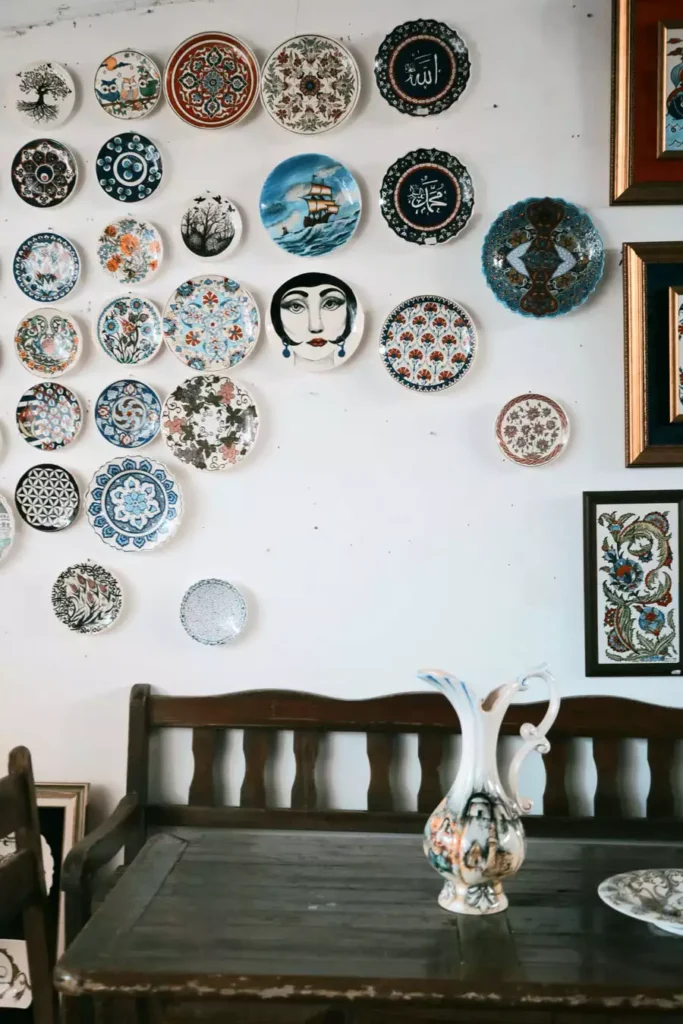
This is one of the densest walls in the bunch: dozens of round ceramic plates in wildly different patterns, florals, geometric mandalas, calligraphy, and a painted ship at sea, all packed edge to edge on a plain white cafe wall, alongside a few framed textile pieces.
The face portrait plate and the ship scene act as visual anchors, since figurative images tend to draw the eye first in a wall full of pattern. Everything else fills in around them without needing to compete.
Below, a worn wood bench holds an ornate white pitcher with painted architecture on it, sitting slightly off to one side rather than centered. A wall this full works because nothing on it is trying too hard to stand out individually; the volume itself becomes the effect.
Lotus Blooms Along a Terrazzo Corridor

Dozens of small ceramic lotus blooms in white, blush, and gold run in a loose, flowing band along a gray terrazzo wall, thinning and thickening as the corridor continues toward a recessed niche. Recessed circular lights set into the ceiling above cast a warm glow that picks out the texture of each individual petal.
The flowers aren’t arranged in rows; they cluster and scatter the way real petals might settle after falling, which suits the flowing, organic feel of the terrazzo pattern underneath them.
This kind of installation makes the most sense in a hallway or corridor meant to be walked through slowly rather than viewed head-on from one spot. A grouping that unfolds as you move past it holds attention differently than a static wall grouping does.
Empty Frames Waiting for Ceramic Company
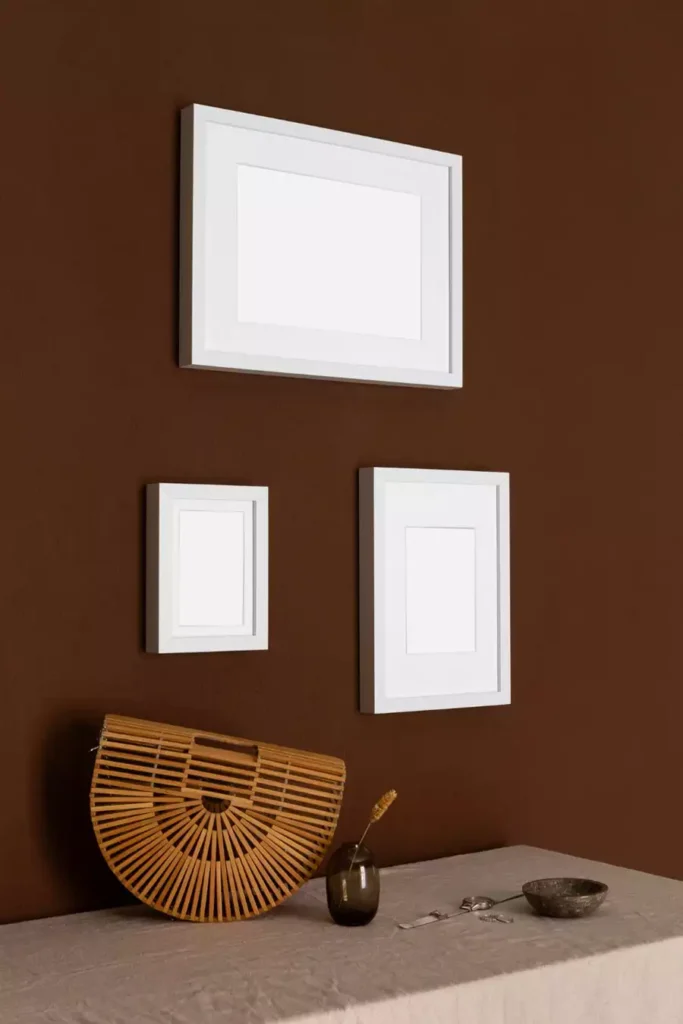
Three plain white frames hang on a deep chocolate brown wall in a simple, uneven layout, one large frame up top and two smaller ones below it, all left empty. There’s no ceramic piece on the wall itself yet.
What makes this useful as a reference is the small styling shelf underneath: a woven half-moon bag, a smoky glass bud vase, a tiny bowl, and a scattering of dried stems. That same shelf is exactly the kind of spot where a scalloped plate or a small sculptural piece could sit instead of hanging, giving ceramic wall decor a resting place without needing to mount anything.
A dark wall like this chocolate brown also makes white frames, or pale ceramic pieces, stand out with far more contrast than a neutral wall would.
An Outdoor Wall Packed Edge to Edge

This stone wall belongs to an outdoor market stall, and it’s covered almost entirely with painted ceramic plates, small tiles, folk-art panels, and tall patterned vases lined up on a narrow stone ledge below. Strong sunlight cuts across the whole wall at an angle, throwing sharp shadows behind every raised piece.
The variety here is enormous: warm earth-toned plates with painted scenes sit next to bright mosaic-style tiles in red, yellow, and blue, and hand-thrown vases with painted animals and geometric bands crowd the ledge underneath.
Direct sunlight like this changes how ceramic glaze reads compared to indoor lighting, deepening shadows and making glossy surfaces flash brighter. If you’re hanging ceramic pieces somewhere that gets real sun, expect the colors to shift throughout the day rather than staying static.
Fan-Shaped Discs in Gold and Black

This piece is more sculptural than the plate-based groupings elsewhere in this list: a cluster of ribbed, fan-shaped discs in gold and black, overlapping like layered petals or shells, mounted above a slim black console table.
The gold discs have a fine, almost hammered texture, while the black ones sit smoother and glossier, and that contrast in finish does more to separate the two colors than the color itself would alone.
Below, a candelabra, a textured vase with olive branches, and a stack of books keep the console simple, and a mustard yellow chair just visible at the edge of the frame picks up the same warm gold tone from the wall piece above.
Zodiac Roundels Above the Kitchen Sink
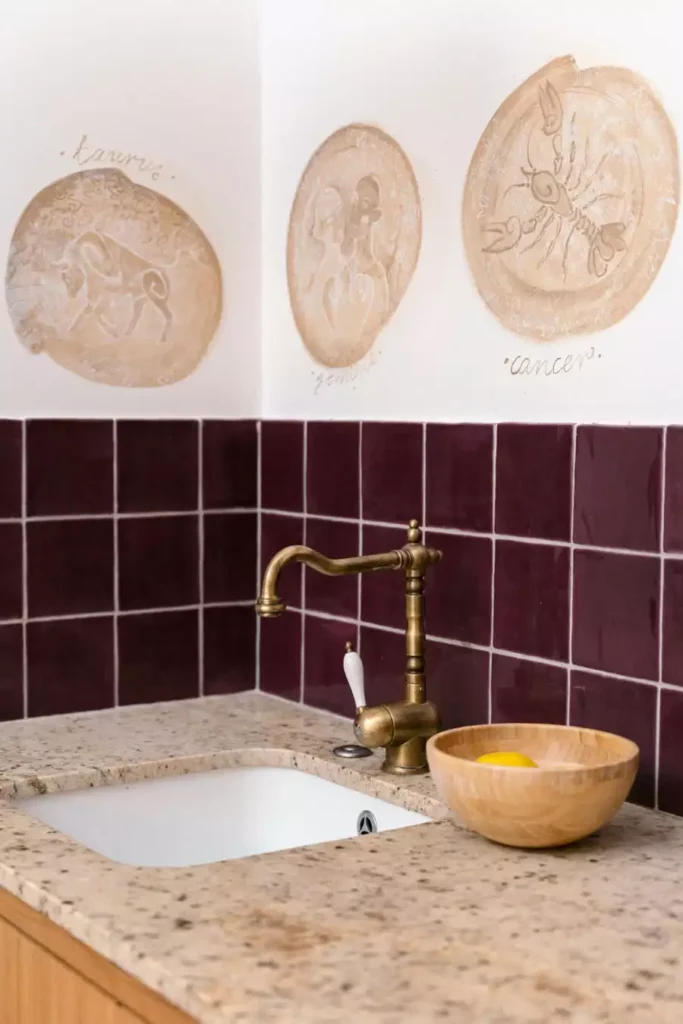
Three carved, sand-toned roundels sit on the wall above a kitchen sink, each labeled in cursive script as Taurus, Gemini, and Cancer, with a simple line drawing of the corresponding symbol pressed into the surface.
They’re spaced unevenly, following the corner of the wall rather than a straight row, and the plain sandy color lets the carved linework do all the talking instead of relying on glaze or paint.
Below, deep burgundy square tiles, an aged brass faucet, and a stone countertop bring in the only real color and shine in the space. Small, low-relief ceramic pieces like these work well in a kitchen precisely because they don’t compete with the tile or hardware underneath them.
A Weathered Wall of Small Handmade Tiles
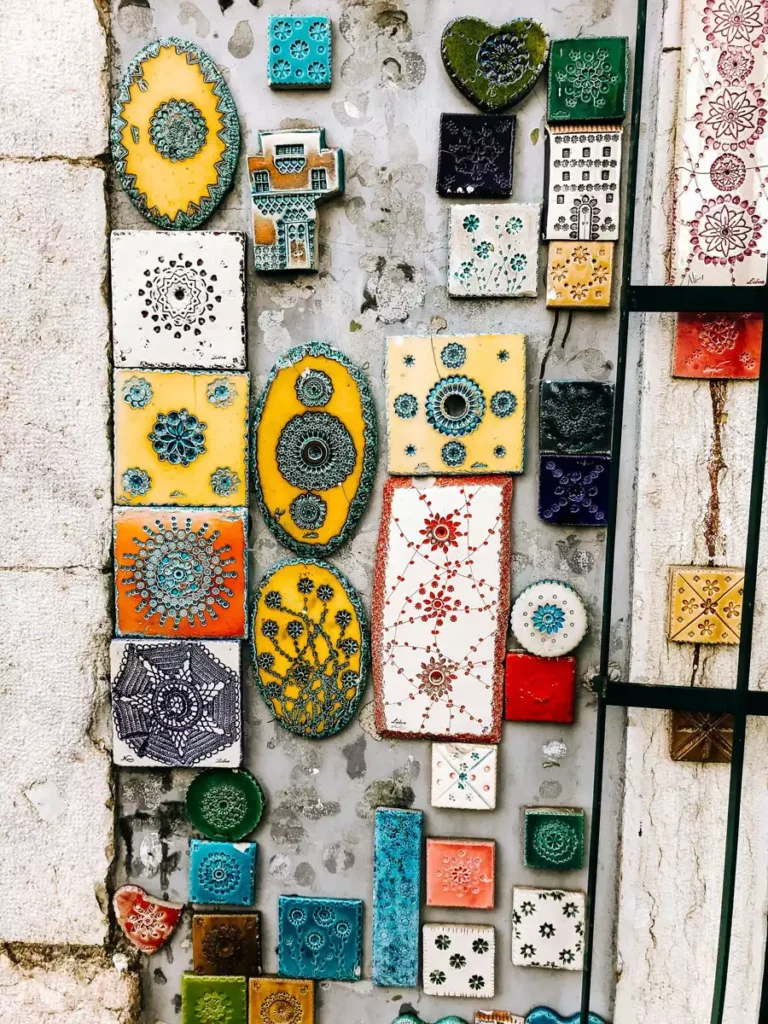
Dozens of small handmade tiles in yellow, teal, terracotta, and white cover this weathered plaster wall, right next to a black metal security grille. Shapes vary constantly: ovals, squares, hearts, rectangles, and even a tiny house-shaped tile, each stamped or carved with its own floral or geometric pattern.
The wall’s cracked, uneven surface actually helps here rather than working against it. Against a smooth, freshly painted wall, this many mismatched tiles might look chaotic, but the texture underneath gives everything a sense of having accumulated over time.
If you’re building a tile collection piece by piece, a wall like this is proof that consistency in shape or size isn’t required. What holds it together is the recurring use of the same handful of colors across every single tile.
Pick One Corner and Start There
Twenty-two walls is a lot to take in at once, and none of them need to be copied exactly. Pull two or three ideas that share a color story or a plate shape, save the images that match your own wall, and start with a small grouping before committing to anything larger.
Ceramic wall decor tends to grow over time anyway; a plate here, a sculptural piece there, so there’s no need to fill an entire wall in one afternoon. Pin the ones that stick with you and come back to them when you find the right piece.